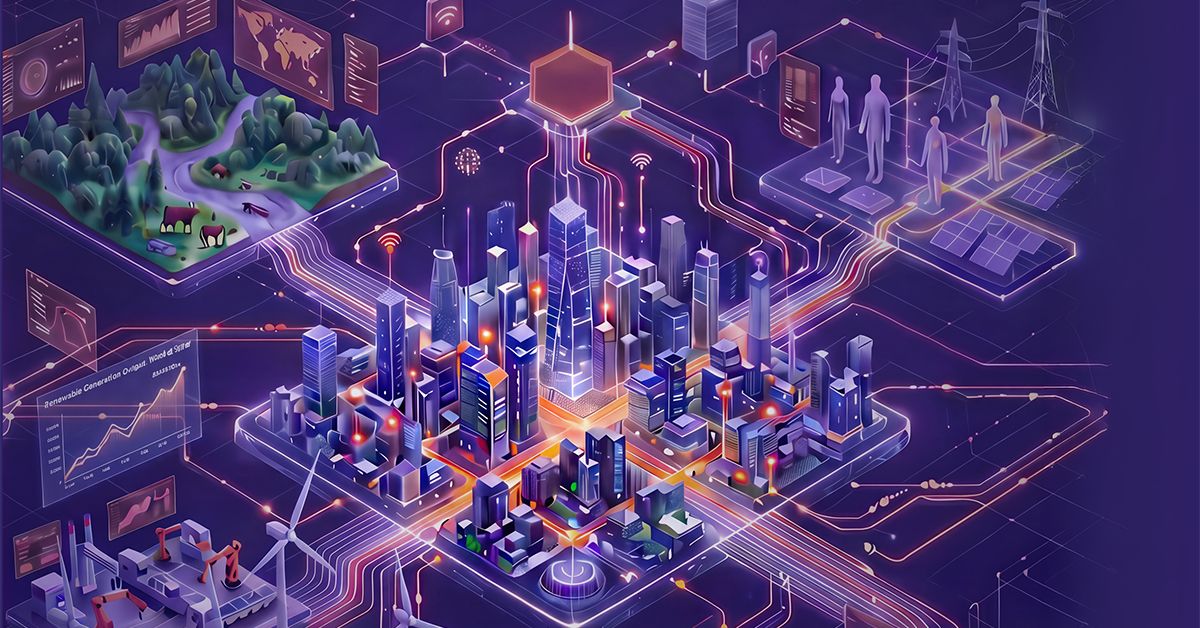
Across industries, the definition of a “product” has fundamentally changed. Automotive platforms are now rolling data centers. Industrial equipment increasingly depends on embedded intelligence and real-time analytics. Aerospace, high-tech, and communications systems are integrating advanced electronics, thermal management, photonics, mechanical engineering, and artificial intelligence (AI) into tightly coupled architectures. Modern engineering now spans from silicon to systems, requiring holistic solutions across across diverse engineering domains and workflows.
For engineering organizations, this shift is no longer theoretical. Product complexity has crossed a threshold where traditional linear development models cannot keep pace with the demands of software-defined systems, compressed market windows, and AI-enabled functionality.
Looking ahead, AI is transforming what we think of as computing itself. Most people today think of AI as an application or an agent that supports an application, but to those on the forefront of AI development, that’s an old-school paradigm of computing that is soon to be toppled. AI isn’t going to be just an application running on top of a traditional operating system. AI is going to become the foundational platform upon which everything else runs.
Paradigm shifts of this magnitude don’t occur overnight, and no shift of this magnitude occurs because of a single hardware or software breakthrough. It occurs because people and organizations work together to create a a set of tools, workflows, and related support models that enable individuals, teams, and organizations to make the most of the possibilities created by this new approach. The next generation of innovative products will not be built within the boundaries of a single tool chain, business unit, or enterprise. They will emerge from ecosystems — interconnected and interdependent teams and organizations that unify silicon design, multiphysics simulation, software development, AI, and systems engineering into a continuous innovation framework.
Synopsys President and CEO Sassine Ghazi and NVIDIA founder and CEO Jensen Huang at Synopsys Converge 2026
The Critical Role of the “Silicon-to-Systems” Ecosystem
“The complexity and cost of developing next-generation intelligent systems demands engineering solutions with a deeper integration of electronics and physics, accelerated by AI capabilities and compute,” says Sassine Ghazi, president and CEO of Synopsys. “We need to re-engineer engineering and empower innovators everywhere to realize their innovations more efficiently.”
In many ways, the idea of re-engineering engineering has been at the heart of the work Ansys, part of Synopsys, has done for years — from students and startups to the largest names in industry.
To better prepare students, the Ansys Academic Program offers simulation software and educational resources to support the teaching of engineering, science, and design curricula. Our free student software has been downloaded more than 4.9 million times.
“Our academic and startup programs have allowed us to thoughtfully engage with these users considering their challenges and how simulation can help overcome them. Our strategy works to lower the barrier to entry of using our tools to drive innovation,” says Susan Coleman, executive director, academic and startup programs at Ansys.
The Ansys Startup Program is built for early- to mid-stage startups with limited funding and revenue. We provide full access to multiphysics simulation software, coupled with high-performance computing, to help startups tackle engineering challenges quickly and cost-effectively.
The program is celebrating 10 years in 2026 and has had more than 3,080 startups across 65 countries join to enable their efforts with the power of simulation.
And, of course, Ansys channel partners provide industry expertise, personalized training, local presence, and consulting services that enable customers to realize the full potential of their simulation needs using Ansys solutions.
Overheard at Synopsys Converge 2026
“When we build today’s most complex multi-die, 2.5D, and 3D chiplet-based designs, we are optimizing across the full system from the very start. Architecture, silicon implementation, packaging, and software all move together. That co-design increasingly spans multiple physical domains: power, performance, thermals, signal integrity, mechanical stresses, and long-term reliability.”
— AMD CTO Mark Papermaster
“To reduce design margins and deliver the highest performance and most efficient silicon, multiphysics analysis is critical. Intel and Synopsys have a long-standing partnership — from bringing advances in silicon technology to powering data centers and physical AI. We are excited to continue our strong partnership with Synopsys into the Angstrom Era with our collaboration on Intel 18A, 14A, and beyond.”
— Intel CEO Lip-Bu Tan
“It’s unbelievable the rate of progress that you’ve been making. All the engineering you’ve done in EDA — building the scaffolding and harness for generative AI — is what’s going to make AgentEngineers the next big driver of productivity. And the world needs that.”
— Microsoft CEO Satya Nadella
“I’m delighted to partner deeply with you in this area,” Huang told Ghazi when discussing agentic AI, noting that engineering capacity — not technology — is now the primary constraint on innovation. “Every one of our engineers will have a whole bunch of Synopsys agents working with them, specialized in different parts of the design.”
— NVIDIA CEO Jensen Huang
“Synopsys’ open ecosystem approach is critical to supporting our customers’ workflows. We are proud to collaborate with a community of over 400 Technology Partners who provide highly specialized software products, HPC, and cloud hosting services that complement Synopsys solutions in a variety of workflows and industries,” says Kim Davis, partnerships vice president at Ansys.
The Ansys Technology Partner ecosystem has made it easy for customers to take advantage of vast materials libraries, process and application integrations, and more, making it possible to simulate complex systems ranging in scale from the atomic to the extraterrestrial.
For example, Synopsys recently inked a partnership agreement with NVIDIA that embeds NVIDIA’s Omniverse technology in Ansys simulation solutions. NVIDIA Omniverse consists of a collection of libraries and microservices that facilitate the development of physical AI applications, such as industrial digital twins and robotics simulation.
For Synopsys, partnerships have historically focused on ensuring that the systems customers design with its tools can be built. No firm wants to invest time and resources in the development of a complex new chip only to discover that it cannot be manufactured. So, Synopsys has developed ecosystem partnerships with companies like Arm, Intel, NVIDIA, Samsung, and TSMC. A recent agreement with TSMC, for example, enables Synopsys customers to use robust electronic design automation (EDA) and intellectual property (IP) solutions that take advantage of TSMC’s most advanced processes and packaging technologies. For companies eager to accelerate AI chip design and take advantage of 3D multi-die design innovations, this kind of partnership is crucial.
“Innovative value creation happens at the intersections,” says Arun Bhattacharya, Synopsys global head of ecosystems marketing. “Synopsys plays a unique role in bringing together the world’s leading technology leaders across the silicon-to-systems value chain, creating an ecosystem where collaboration accelerates innovation, unlocks new opportunities, and delivers greater value to customers worldwide.”
Synopsys has also cultivated partnerships throughout the broader engineering ecosystem, including supply chain partners, strategic partners, academic partners, and channel partners. Developers can easily integrate prebuilt components — I/O or network interfaces, for example — into their designs, eliminating the need to design those from scratch.
At the same time, Synopsys’ incorporation of Ansys simulation technologies provides developers with the ability to conduct more of their development efforts in simulation. As chip designs grow more complex and as economies of scale drive even more extreme co-design efforts, system designers will rely on system simulation to an ever-greater degree. Fortunately, the partnership between Synopsys and NVIDIA is making it increasingly easy for designers working with simulation tools from Synopsys to accelerate their simulations. Using NVIDIA CUDA-X libraries and AI-Physics technologies, Synopsys is accelerating and optimizing its portfolio of compute-intensive applications, ensuring that ever more complex models can be constructed, tested, and refined in simulation.
The impact of these partnerships extends well beyond the ability to create simulations that validate the designs of ever more complex chips. These simulations position engineers to develop and validate software long before the physical hardware itself is available.
Expanding the Power of Digital Twins
The simulation of whole systems — whether at the level of an integrated circuit or the level of a factory — has long been recognized as a powerful tool for enabling efficiencies in the development, management, and refinement of complex systems. With a validated digital twin of a given system, designers can test what-if scenarios to explore different ways to achieve innumerable desired effects — to improve cache performance on a chip, to reduce emissions from a manufacturing facility, or to alter an entire supply chain to ensure a more reliable, environmentally friendly, or timely stream of raw materials — all without compromising the production systems already in use.
Ultimately, the strength of such digital twins depends upon the strength of the partner ecosystem supporting those twins. Not only does that mean the simulation tools themselves must be capable of enabling designers to create digital twins by drawing from rich libraries of materials, protocols, interfaces, and more, but that also means that the partnerships have been cultivated to ensure that there is an infrastructure that can support the digital twins that designers want to construct.
In terms of digital twin design, the richness of the ecosystem supporting the simulation tools from Ansys is well established. Where the richness of the ecosystem partnerships cultivated by Synopsys stands out is apparent in the options for deploying digital twins at scale. Synopsys works closely with providers like Microsoft and AWS to ensure that customers building digital twins have the compute, storage, memory, and network resources required to run these complex models.
A Re-Engineered World
The ecosystems cultivated by Synopsys combine to create a powerful force for innovation and success. By fostering collaboration and incorporating the expertise of partners, we can enable organizations to tackle the most complex engineering challenges, accelerate innovation, and deliver exceptional value — particularly in a world where AI seems to be on the verge of transforming so many aspects of life. We need to build the systems that enable us to make the most of the possibilities enabled by AI, and partnerships lie at the heart of this effort. They empower organizations to take bold leaps forward. Together with our partners, Synopsys is not just solving problems — we’re building a foundation for the innovations of tomorrow.
Check out the "Leading the Innovation Ecosystem" issue of Ansys Advantage magazine for examples of how Synopsys customers and partners benefit from our ecosystem.