Home
Blog
AI Governance & Security
Enterprise MCP
Perri Bronson
Director, Solutions Marketing
Nov 20, 2026
IT and Enterprise Systems teams can be enablers of AI innovation without allowing unnecessary risks. Here is how two teams are doing it.
Governing vibe coding in the enterprise means letting anyone build while IT controls how AI agents, MCP servers, and workflows connect to business systems. The pattern that works has three parts: put a governed orchestration layer between AI and your data, tie every project to a defined outcome, and consolidate onto fewer platforms.
Why is vibe coding an enterprise risk?
Speed is no longer the constraint. Anyone with an AI coding assistant can stand up an app, an agent, or an MCP server in an afternoon. The risk is the unvetted, direct-to-production version of that: assistants, plugins, and servers nobody approved, wired to systems nobody scoped.
Carter Busse, CIO at Workato, has seen this play out inside his own company and in conversations with other CIOs. His advice: “Get in front of it. Go build those MCP servers, because the power of these LLMs hooked up to your company data transforms the way people work.”
Al Linke, VP of Enterprise Applications, Data & AI at SentinelOne, describes the enterprise orchestration side of that approach in one line: “Everything that moves from point A to point B is built on Workato.”
Why invest in governance at all?
Because governance is what makes AI spend defensible. The business case for scaling AI is business impact and ROI, and both teams below got there by starting narrow.
Linke’s team prioritizes by outcome: “We take a very specific use case, like renewals automation, with a very specific defined outcome, very clear ROI, and that’s basically how we prioritize projects here. We’ve got to make sure we’re working on the things that move the needle. Hyper-growth companies obviously want to focus on projects that have a direct tie to revenue.”
At Asana, Maschal Malek, Product Manager for Enterprise AI, saw the same discipline pay off: “Adoption was at 86% by the end of the quarter, and we were able to get a 10% increase in bookings within that first quarter. Our goal was really not even to get increased bookings. Our goal was to lower research time for accounts and prospects for our reps.”
How do you scale governance without killing velocity?
Start with a platform that offers both speed of development and governance and guardrails. Then apply three design rules.
In Workato, the MCP Control Plane governs MCP servers you compose, Workato’s prebuilt servers, and third-party servers connected by proxy. Each server authenticates users by API token, Workato Identity credentials, or SSO through an external identity provider such as Okta. Access is explicit: users, including workspace admins, must be added to an end-user group before they can reach a server. Teams can also add rate limits, usage quotas, and IP restrictions per server.
Tool-level role-based access control (RBAC) lets admins grant a group access to a server, then restrict which tools that group can call, without standing up duplicate servers for different audiences. Verified User Access carries the caller’s identity through to the underlying app, so backend calls to systems like Salesforce or Gmail run under that user’s own identity and permissions instead of a shared service account.
Choose a unified control and execution platform that lets business users and engineers build in the same governed environment. Linke made this a buying criterion: “I wanted a platform that I could empower my business as well. So not only is my team going all in, but we also have quite a few business users that are doing some pretty cool things on Workato as well.”
Flexibility matters here too. Malek put it this way: “The whole point here was flexibility, because we know in this AI era, things change very quickly. We could be changing our tools very quickly, and so we want to make sure that what we build is future-proof.”
Enterprise MCP servers are the bridge between your business systems and your AI agents and tools, which makes them the natural place to apply governance.
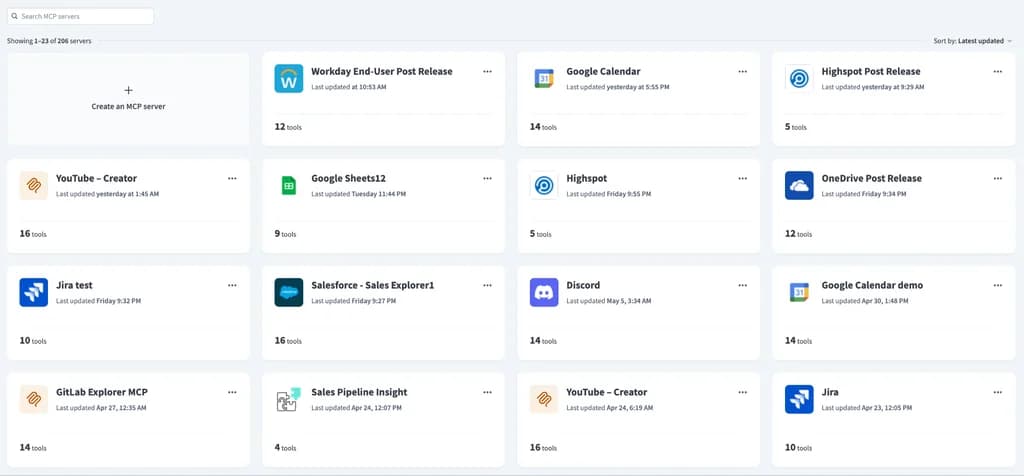
Start with a registry. Workato’s MCP Registry is a central catalog of the MCP servers in your organization, covering servers your teams compose, prebuilt servers, and third-party servers added through proxy. Each entry lists the server’s name, description, available tools, and ownership. That gives builders, admins, and agents one source of truth and cuts down on duplicate servers.
Then decide where to build. SentinelOne, a security company, built quite a few of its MCP servers on Workato even when a first-party server existed. Linke explains: “In some cases there was an MCP from our first party, but we chose to build it on Workato because that gives us additional controls in terms of auditing, logs, and observability. There’s a kill switch if something goes rogue, so that’s been really nice.”
Behind that, the documented controls are concrete. Server-level logs capture the calling user, authentication method, source IP, tool name, inputs and outputs, duration, and success or failure, and can be streamed to a SIEM. Revoking an API token immediately disconnects every client using it, and administrative actions such as adding, removing, starting, or stopping tools are recorded in an audit trail.
Asana cited visibility as the deciding factor. Malek: “Within Claude, it’s very hard to figure out how people are using it and how many people might actually be utilizing our MCP. With Workato, we’re able to attach numbers to it all. We can see how many active users we’ve had, tool calls, token usage, success rates. We can see the tool calls over time, who our top users are, as well as the top tools called.”
On native MCP servers, she was direct about the gap: “A lot of this is governance and the ability to really have guardrails in place, and cost is another thing.”
How do you build faster inside the guardrails?
With AIRO, Workato’s AI automation engineer. Behind each conversation is a team of specialized AI agents. For a full build, the Solution Architect pipeline takes a PRD or a natural-language description through requirements analysis and produces a blueprint, then builds the automations, agents, APIs, and MCP servers it calls for. AIRO is also available from MCP-compatible clients such as Claude Code and Cursor through the AIRO MCP server, so developers can build and manage Workato assets without leaving their own environment.
Busse’s team uses it daily: “It’s like you have a systems architect of Workato sitting next to you, building Workato assets. It can build MCP servers, connectors, recipes, data tables. It can build all this for you in a natural language process, and it builds it with efficiency and documentation and the testing built in. My team starts with it every day to build new automations, and they’re using it to refactor recipes. We have thousands of recipes, and we’re refactoring them, making them more efficient, embedding AI into the recipes to make them actually shorter. It’s been game-changing for us.”
One practical note from the docs applies to any AI-assisted build: AIRO’s suggestions can occasionally be inaccurate or incomplete, so review and test generated content before it reaches production.
What does governance have to do with cost?
Cost sits right next to security as you scale, and orchestration can save money while unlocking value.
Malek on Asana’s build: “It was cost-effective, as you saw, with 10 cents per deliverable at the time, and we had a lot more control over security and governance. Where is our data going as a company? Where is it being stored? Who has access to it? What pieces of data are we providing to AI, rather than giving it full access to different tools and trusting that maybe a tool is not a bad actor? All this to say, 90% of our engine that we build is actually go-to-market systems powered by Workato orchestration.”
On the revenue side, Linke: “Through the power of really good orchestration, which we get through Workato, plus the magic of agentic coding, we stood up an application that automates all of our renewals under a certain threshold, as well as the upsell quote, and so we’re now seeing a 14% uptick on upsell quote acceptance. You’ve got to have the AI piece, but you’ve got to have good old-fashioned, really good orchestration to pull off some of those use cases.”
On token spend, Workato applies the same approach to its own AI usage. Workato’s Model Gateway is a single OpenAI-compatible point of control between applications and LLM providers, with routing and policy enforcement for rate limits, token limits, and IP access.
It is currently available to select customers. Busse shared Workato’s internal result: “We’ve seen our token costs go down by 60% between using our LLM gateway and using a combination of foundation models and third-party models. So that has been game-changing.”
Should you use one AI platform or best-of-breed point solutions?
Both teams landed on consolidation. Linke: “I want one platform to be my LLM gateway, my agent identity, my MCP gateway. There’s no reason in my mind to go best of breed on this. It’s just going to be a nightmare to manage, and I don’t think it’s going to be as secure if we have multiple players in this space.”
Malek made the same call for Asana: “We decided it was more cost-effective and we had more control to build with our own internal systems for AI instead of buying solutions, and Workato One has been such a great platform for us to use to get to where we need to.”
- Stand up a registry for approved AI assistants, plugins, and MCP servers.
- Put every MCP server behind one control plane with SSO, group-based access, and tool-level RBAC.
- Log every tool call and stream the logs to your SIEM.
- Pick one deep use case with a defined outcome tied to revenue or time saved.
- Consolidate toward one platform before the next round of point solutions arrives.
FAQ
What is vibe coding governance?
It is the set of controls that let anyone build with AI while IT keeps visibility and control over what gets deployed and what data it touches. In practice that means a registry of approved servers, authenticated and group-based access, tool-level permissions, and centralized logging.
How do you secure MCP servers in the enterprise?
Route them through a control plane that authenticates every user, limits which servers and tools each group can reach, and logs every call. In Workato, that includes SSO through your identity provider, tool-level RBAC, rate limits and quotas, and server-level logs you can stream to a SIEM.
Why build an MCP server on an orchestration platform instead of using a native one?
Visibility and control. Asana found it hard to see how people were using native MCP servers, and with Workato could see active users, tool calls, token usage, and success rates. SentinelOne chose Workato for auditing, logs, and observability.
Choose a specific use case with a defined outcome. SentinelOne’s renewals automation produced a 14% uptick on upsell quote acceptance, and that direct tie to revenue is how Linke prioritizes projects.
Put a gateway between your applications and model providers so you can route across models and enforce token and rate limits in one place. Workato’s CIO reports a 60% reduction in token costs using this approach internally.
Linke wants one platform for his LLM gateway, agent identity, and MCP gateway, and expects multiple vendors to be harder to manage and less secure.
More on AI Governance & Security, Enterprise MCP
Discover the latest product updates and features
What Does an AI Control Plane Include?
Nov 11, 2026
AI Control Plane vs AI Gateway: What’s the Difference?
Nov 11, 2026
AI Gateway vs API Gateway: Do You Need Both?
Nov 11, 2026
Table of Contents