Smart Summary
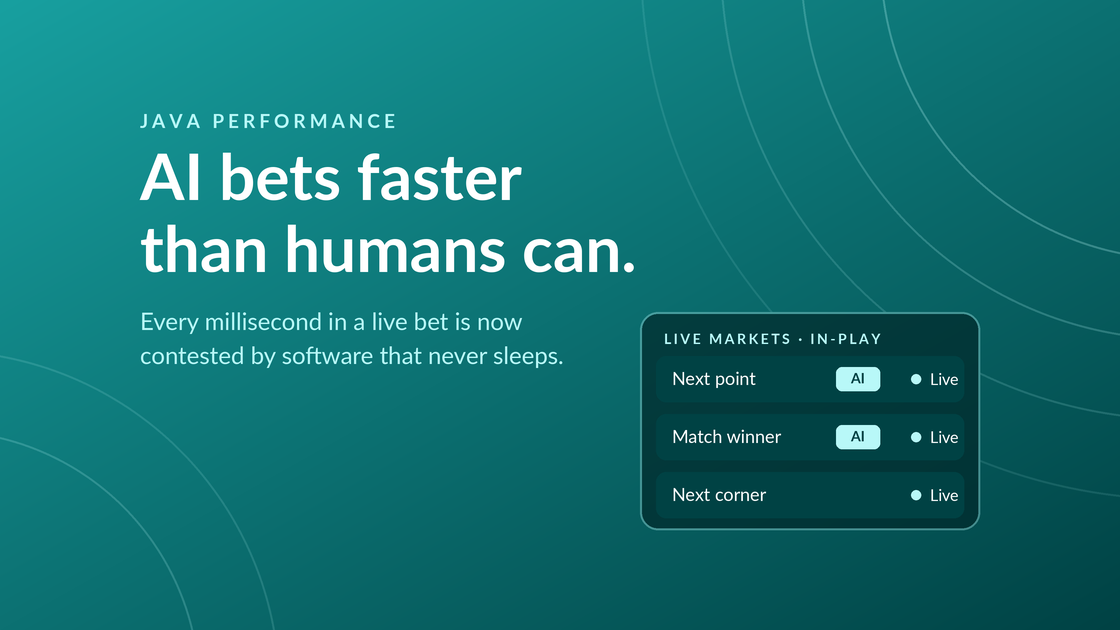
Sports betting and online gaming have always required very fast responses, because odds change quickly, and each bet must be accepted or rejected almost instantly. AI now operates at that same speed. Worldpay’s 2026 research describes autonomous betting agents, software that places bets without human input, that scans markets for small timing gaps. Java runs much of the infrastructure behind these platforms, so the speed of the Java runtime now directly affects whether a platform can keep up with this new challenge.
In this post you will learn:
- Why AI now runs alongside the bet, inside betting and gaming platforms
- How autonomous betting agents exploit the latency window a standard JVM leaves open
- Three costs of running standard OpenJDK: fraud checks that lag the bet, performance that buckles at peak traffic, and paying for extra servers as a safety net
- How Azul Prime’s Falcon JIT, C4 pauseless garbage collector, and ReadyNow address each problem, with little or no application code changes
Sports betting and online gaming have always depended on low latency, meaning very fast response times. AI adds a new challenge. Worldpay’s 2026 analysis of agentic AI in gambling describes autonomous betting agents that evaluate markets in milliseconds, exploit timing gaps, and place opposing bets across operators to lock in profit, at speeds no human can match (Agentic AI is changing the odds in gambling).
AI is also now central to these platforms rather than peripheral. It recalculates in-play odds as a match unfolds, personalizes offers and game experiences in real time, and screens transactions for fraud before they clear. Each of these tasks now has to meet the same millisecond timing as the bet itself.
Java still runs much of this infrastructure. It handles heavy concurrent user loads, moves data across platforms without friction, and has powered mission-critical backends for two decades. Today’s challenge isn’t the Java language, but that a standard OpenJDK runtime was never for AI workloads that must respond at betting speeds. That performance ceiling has been there all along, and AI has exposed it.
The Java Bottleneck Nobody Budgeted For
Betting and gaming platforms run Java backends that already do several demanding things at once: process payments, calculate live odds, accept in-play bets, and run fraud checks, all within milliseconds. AI adds another latency-sensitive workload to that list.
A standard OpenJDK build wasn’t designed for this combined load. If the gap isn’t addressed, it shows up in three familiar and costly ways:
- Fraud checks that fall behind the bet. High latency and slow processing delay the AI-driven decisions that protect the business.
- Performance that buckles at peak moments. Kickoff, a title fight, or a viral in-game event bring traffic spikes, and that is when Java garbage collection pauses and JIT compilation overhead are most likely to surface.
- Overprovisioning as the only safety net. Teams run extra infrastructure around the clock to survive peak load and overcome slow scaling. That excess shows up directly in cloud spend.
The root cause is the runtime, and it’s fixable.
What a High-Performance Runtime Actually Changes
Azul Prime is a high-performance, OpenJDK-based Java platform built to remove these bottlenecks with little or no application code change. It absorbs agentic AI demand with more throughput and lower cloud spend. Prime addresses the problem in three ways:
- Real-time odds and fraud engines get the responsiveness they need. Prime’s Falcon JIT delivers faster, more consistent code execution than standard Java performance.
- Performance stays consistent under peak traffic instead of degrading under strain, thanks to Prime’s C4 pauseless garbage collector.
- Server capacity scales on demand instead of sitting at inflated baseline capacity as a precaution, thanks to Prime’s ReadyNow.
Together, these give betting and gaming platforms the consistent low latency that peak events, fraud engines, and AI-driven personalization depend on. They also free up engineering time that would otherwise go to firefighting. In a Total Economic Impact of Azul Prime study commissioned by Azul, Forrester modeled the value of engineer hours reallocated to higher-value work at $5.7 million over three years.
What Betting Can Learn from Video Gaming
Video games don’t settle wagers, but they share some of the same pressures as online betting and gaming platforms: real-time responsiveness at massive, unpredictable scale and players who notice any delay.
Jagex is a global game developer and publisher headquartered in Cambridge, UK. Its game RuneScape is listed by Guinness World Records as the most prolifically updated MMORPG. RuneScape runs on a 600-millisecond game tick, the heartbeat that governs everything from combat to movement. A JVM pause that crosses that threshold is felt by players as a game stutter. Standard OpenJDK garbage collection pauses were causing exactly that.
After moving to Azul Prime, Jagex saw the following results:
- Eliminated every pause over 600ms, erasing the pauses players could actually detect while playing.
- Improved overall gaming performance by 20%.
The Bottom Line
AI didn’t wait for betting and online gaming platforms to get ready. It operates at the same speed as the bet itself, and the agents built to exploit any lag moved in right behind it. This isn’t a future problem. Platforms are dealing with it today.
Azul Prime keeps your JVM from becoming the bottleneck, with fewer stalls during peak load, faster warm-up when scaling, and meaningfully lower infrastructure costs. That lets betting and gaming platforms keep pace with what their players and their own AI now expect.
Frequently Asked Questions
Why does Java performance matter in real-time sports betting and online gaming?
Betting and gaming platforms settle odds, accept in-play wagers, screen for fraud and personalize offers within milliseconds, and most of that work runs on Java backends. When the Java runtime stalls, whether for a garbage collection pause or while just-in-time (JIT) compilation warms up, those decisions arrive late. Azul Prime is a high-performance, OpenJDK-based Java platform built to reduce those stalls without any application code changes.
What causes a Java application to slow down during traffic spikes?
Two issues usually appear at the worst moment. Garbage collection pauses stop application threads to reclaim memory. Just-in-time compilation means newly started instances run unoptimized code until they warm up. Both get worse as load climbs, which is why performance degrades at kickoff or during a viral event. Azul Prime addresses these with its C4 pauseless garbage collector, its Falcon JIT compiler, and ReadyNow, which lets new instances start already warmed up.
Can JVM performance be improved without changing application code?
Often, yes. Some performance problems blamed on an application actually come from the runtime underneath it. Because Azul Prime is an OpenJDK-based Java platform, many applications can move to it without refactoring, rewriting, or re-architecting, and keep running on the same infrastructure. As an example, Azul customer Jagex eliminated every garbage collection pause over 600 milliseconds in RuneScape and improved overall gaming performance by 20% by moving to Azul Prime.
How are AI agents changing the latency requirements for betting platforms?
Worldpay’s 2026 research on agentic AI in gambling describes autonomous agents that evaluate markets in milliseconds, scan multiple operators at once, and exploit timing gaps at speeds no human can match. Performance targets are now set by machine speed, not human reaction time. Operators’ own AI systems face the same constraint: live odds, personalization, and fraud screening must meet the same millisecond timing as the bet. Azul Prime aims to provide those workloads with consistent, predictable latency under peak load.
![Email Marketing Guide for Small Businesses [Tactics + Top Tools]](https://active-campaign.transforms.svdcdn.com/production/general/smb-email-marketing.png?w=1200&h=630&q=82&auto=format&fit=crop&dm=1791575718&s=25e9185b525a52f308166dac40808d87)