The gap between AI ambition and operational readiness is driving demand for validated use cases, trusted infrastructure and a more predictable path to deployment.
Across Europe and the Middle East, 93% of organisations planned to increase AI investment in 2026, yet fewer than half of AI proofs of concept successfully transition into production.¹ At the same time, many organisations are still developing their AI governance frameworks despite 99% acknowledging data sovereignty will remain a priority over the next five years.² Delivering AI value requires more than models and infrastructure, so CIOs are looking for a clear path from business requirement to deployment.
Combining proven use cases with the right infrastructure and operational expertise is the foundation of Lenovo’s AI for All vision, helping customers deploy and scale AI across devices, edge environments, private infrastructure, sovereign clouds and the data centre.
Proven paths to AI value
The next phase of AI adoption in Europe will be defined by how organisations move from experimentation to deployment at scale. CIOs need to think beyond model performance and consider the economics of AI itself and its ability to operate securely, efficiently and predictably within real-world business environments. This is driving a shift in how AI investments are evaluated with cost, latency, governance, compliance and operational control becoming just as important as accuracy.
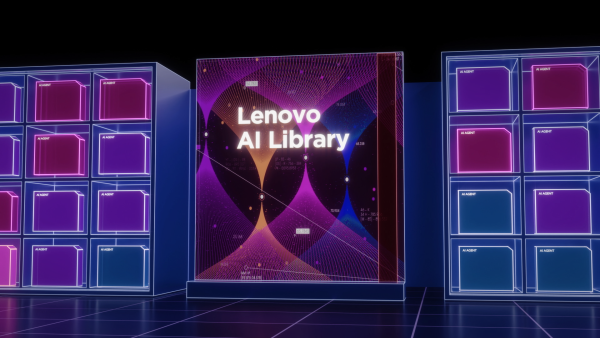
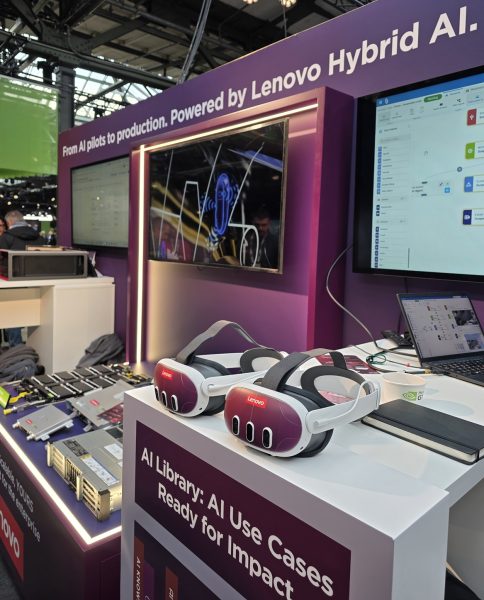
So, if the challenge is moving AI from pilot to production, organisations need proven use cases that can be deployed, governed and scaled with confidence. This is the thinking behind Lenovo’s AI Library, a growing collection of production-ready agents and validated use cases that combine infrastructure, software, services and industry expertise into repeatable solutions. From enterprise knowledge assistants and retail agents to computer vision and edge AI orchestration, the use cases in the Lenovo AI Library accelerate the path from business requirement to measurable outcomes.
While 94% of IT decision-makers expect positive returns from AI investments¹, many are still looking for a more predictable path to achieving them. Lenovo and its ecosystem partners are helping customers apply AI to real-world challenges across industries and accelerate time-to-value with the recently announced Lenovo AI Library use cases that enable selected deployments to reach production in as little as one week.³
Controlling Europe’s AI operations and environments
For European organisations, control over data and AI is becoming a competitive requirement, not simply a compliance consideration. Research shows 88% of IT decision-makers already see data sovereignty² as a priority as regulatory obligations, intellectual property protection and data-residency requirements shape where information can be stored and processed.
Sovereignty requirements are driving the demand for AI architectures that keep enterprise data, models and operations within customer-controlled environments. The aim is not to place every workload in the same environment. Hybrid AI has become the practical default because it enables customers to build an AI operating model that lets them run the right model in the right place, with a clear view of the value it creates. With 82% of organisations in the region expecting to run AI workloads across on-premises or edge environments¹, the task for CIOs is to make those choices deliberately, balancing business value, data location, responsiveness and the operating model needed to support them.
Lenovo Hybrid AI Factory with NVIDIA solutions including Lenovo AI Inferencing Servers provide a choice of infrastructure for business workloads of different sizes. NVIDIA Minerva can help teams manage AI infrastructure availability and performance as environments scale. For organisations moving into agentic AI, the Lenovo xIQ Agent Platform provides a route to develop, deploy and govern agents within their wider AI environment.
Trust and security in Europe’s AI environments
Trust is a condition of scaling AI from day one. As organisations use proprietary data, deploy agents that can take action, and operate across multiple jurisdictions, they need confidence in how data, models, prompts and outputs are protected and governed.
For many European CIOs, sovereignty is central to that confidence. It is not simply a question of data residency; it is the ability to retain meaningful control over the environments in which AI is developed and operated. That requires a practical combination of infrastructure, software, policies and expertise.
Lenovo, IBM and NVIDIA are collaborating on Sovereign AI Factory solutions designed to help customers operate on their own terms. Lenovo AI Services help translate governance requirements into deployment choices as customers combine scalable Hybrid AI infrastructure, an integrated data layer and production inference software.
- Lenovo’s Knowledge Super Agent provides a validated route into agentic AI, with governance, integration and scalability considered from the outset.
- Next-generation AI infrastructure such as NVIDIA Vera Rubin and NVIDIA BlueField provides the performance and scale required to support increasingly sophisticated AI workloads as organisations expand from initial deployments towards enterprise AI factories.
- NVIDIA Confidential Computing, NVIDIA OpenShell Reference Architecture, and NVIDIA Sentry provide the latest capabilities for protecting sensitive AI workloads and models, governing agent activity and enforcing runtime security.
European organisations increasingly want the flexibility of open models without compromising security, governance, transparency or operational control. This is where open and private AI intersect. The NVIDIA AI Enterprise software – including NVIDIA NIM containers, NVIDIA NeMo frameworks, NVIDIA Nemotron models with the NVIDIA Agent Toolkit – gives organisations access to powerful models and innovation tools, while customers deploy, operate and control them on Lenovo infrastructure.
By combining open innovation with private AI infrastructure, organisations can run AI where it makes the most sense for their business, from a single AI server to an AI factory, while maintaining control over data, models and outcomes.
Physical AI in practice
AI’s impact extends beyond digital assistants and knowledge work. Physical AI is bringing intelligence into the environments where organisations make, move, inspect and operate: manufacturing lines, warehouses, retail spaces, transport systems and vehicles. Here, the CIO challenge is to connect AI ambition to real-world reliability, safety and measurable operational improvement.
Lenovo’s Physical AI solutions apply computer vision, robotic inspection, intelligent automation and vehicle computing to these operational environments. They help organisations move beyond isolated demonstrations towards systems that can support decisions and actions in the physical world.
In mobility, Lenovo’s AD1 Level 4 autonomous-driving AI computing platform, built on NVIDIA DRIVE AGX Thor and part of NVIDIA Hyperion, is supporting autonomous-driving programmes with customers and partners including Nuro, WeRide and SWM.ai. At NVIDIA GTC Europe, Lenovo will showcase Vehicle Computing alongside its wider computer vision and robotic inspection portfolio, helping organisations turn physical AI opportunities into deployable solutions.
In a market shaped by AI urgency, supply pressure and pricing uncertainty, delivering AI value requires a clear path from business requirement to deployment.
Lenovo recently introduced AI Express with NVIDIA, combining validated configurations, upfront pricing, curated software and services, and a standardised process from order to shipment. By reducing complexity and accelerating deployment with faster shipping, Lenovo AI Express helps organisations move from AI ambition to measurable business outcomes with greater confidence.