- Blog
- Email Marketing For B2B
October 30, 2026
Email marketing for B2B is the use of email to guide a buying committee from first interest to signed deal, usually over months and across several roles. It works best as a listening system. Your contacts send faint signals long before they reply, and your job is to read those signals and act first.
A B2B buying committee can spend months evaluating you while sending almost no visible signals. Most teams wait through that quiet stretch. This guide shows how to use segmentation, role-based nurture, scoring, and CRM data to respond before the buyer says a word.
You'll also see where B2B email differs from B2C, which deliverability habits matter in corporate inboxes, and how to show email's contribution to revenue when deals take months to close. For the wider picture, start with our guide to B2B marketing strategies.
How is B2B email marketing different from B2C email marketing?
B2B email marketing differs from B2C in four ways that change what you send, to whom, and how you measure it:
- Longer sales cycles: nurture runs for months, not days.
- Multiple decision-makers: one message can't serve five roles.
- Higher purchase stakes: reducing risk beats creating urgency.
- Heavier education needs: buyers want proof, process, and ROI math more than promotions.
Long cycles leave gaps between conversations, and email's job in those gaps is to add value and stay top of mind. Because you own the list, you can keep showing up for as long as someone remains a contact. One email eventually lands at the right moment, and you're the first name that comes to mind.
Tone travels differently too. A playful B2C voice doesn't always translate, since some business buyers want a serious, straightforward message. A distinctive voice can still set you apart if you commit to it.
Metrics shift with the cycle. Opens and clicks are leading indicators, but the outcomes that matter are lead quality, deal velocity, and pipeline contribution. Judge a program by whether it moves deals.
Corporate inboxes reward restraint
Corporate inboxes and spam filters tend to be stricter than consumer ones, so list hygiene and send restraint matter more than volume. ActiveCampaign handles cleanup in the background with automated list hygiene and tagging, which contributes to a 94.2% deliverability rate and a first-place ranking from EmailTooltester. That test covers senders in general, so read it as a sign of strong infrastructure and keep watching your own inbox placement.
If you draft B2B emails with AI, watch the patterns it tends to produce at scale. Inbox providers respond to repetitive structure, generic language, a buried first sentence, and low engagement, so engagement is the signal to protect.
Use this checklist when AI drafts your B2B emails:
- Lead with the reader's benefit in the first sentence.
- Keep one primary ask and one destination.
- Vary the opening angle across a series.
- Set a word count before you generate.
- Run a QA pass for spam-trigger phrases, competing CTAs, and filler.
Five highest-leverage B2B considerations
- Write for the buying committee, not a single contact.
- Segment by role and behavior.
- Plan the whole lifecycle before the first send.
- Connect email to your CRM so reps see what buyers read.
- Judge results by deal movement.
How to adapt your email marketing strategy to a B2B audience
Before you write a single email, settle who you're talking to and how to group them. Three steps lay that groundwork: define your audience, segment it, and personalize to each group.
1. Define your ICP and buyer personas
An ideal customer profile (ICP) describes the company you want to win, and buyer personas describe the people inside it. You need both, because the company decides fit and the person decides what to say.
Gather these inputs for each:
- Industry
- Company size
- Role
- Pain points
- Buying triggers
- Objections
Pull that research from the places buyers actually talk: CRM win and loss data, sales call notes, customer interviews, and support tickets.
2. Segment by firmographics, behavior, and lifecycle stage
Segmenting a B2B list means grouping contacts by company traits, actions, and stage so each group gets a message that fits.
These are the core B2B segmentation dimensions:
- Industry: speak in the buyer's own terms.
- Company size: match the proof to the budget and team.
- Role or seniority: separate executives from end users.
- Funnel stage: send awareness content to new contacts and ROI proof to late-stage ones.
- Behavior: act on site visits, content downloads, and email clicks.
- Engagement level: send more to active contacts and less to quiet ones.
- Customer lifecycle stage: separate prospects, new customers, and long-term accounts.
Sending the same email to an unsegmented list drags down engagement and, over time, deliverability. Segments also need enough people to be worth a send. Check segment size before you build, since a very small segment may not justify a dedicated email. Build narrow segments from behavior, such as past event attendance and email-course engagement, so they stay large enough to matter.
AI-Suggested Segments scans your contact data for high-impact patterns, such as product interest or engagement trends, that are easy to miss by hand. That helps you stop blasting low-intent contacts. A person should still confirm each suggestion reflects a real trigger for your business, since AI reads patterns in your fields without knowing which ones matter.
3. Personalize B2B emails based on role, industry, and intent
Personalization matters more in B2B than in B2C, because the purchase carries higher stakes and faces committee scrutiny. First-name personalization no longer registers with business buyers. A message that speaks to a buyer's role, industry, and stage is more likely to earn a reply when five people have to agree.
You can’t just use first name anymore. That’s kind of a copout in terms of personalization.
You can’t just use first name anymore. That’s kind of a copout in terms of personalization.
Four approaches work, and each has a concrete use:
- Role-based messaging: show a CFO the payback period and an end user the daily time savings.
- Industry-specific pain points: open with the problem a nonprofit director or a logistics manager actually has.
- Behavioral triggers: follow a pricing page visit, a webinar, or repeat case study views with a relevant next step.
- Dynamic content blocks: swap proof points by segment so one email carries the right customer story for each group.
Industry language adds another layer. Use the buyer's own terms, like supporters and volunteers for a nonprofit, because every industry names its buyers differently. AI drafting now makes that vocabulary practical across many industries.
Personalization stays shallow when CRM, forms, and inbox data live in separate tools. ActiveCampaign's 1,000+ integrations pull context from your broader martech stack into one place, so each message draws on the full picture.
UBITS, a B2B learning platform, used segmentation, tagging, and predictive sending to raise its email click-through rates, which shows what this groundwork can do. You can read the full UBITS story.
An email nurture sequence for the long B2B sales cycle
A B2B nurture sequence moves contacts through six stages, and each stage has one email goal and one content type. Decide the action you want, the downstream steps, and the triggered follow-ups before the first send, because opens and clicks alone hide whether anyone acted.
Build the sequence in these six stages:
- Awareness: an educational guide or industry benchmark.
- Consideration: a comparison framework or webinar invite.
- Decision: a customer story, ROI proof, or demo offer.
- Onboarding: a milestone-based setup series.
- Retention: usage tips and check-ins.
- Expansion: upsell or cross-sell triggered by usage milestones.
Behavior, a score threshold, or a deal stage change moves a contact from one stage to the next. Trigger onboarding, retention, and expansion emails from product usage, such as a message that says what the contact did and what to try next, instead of relying on value or offer messaging at those stages.
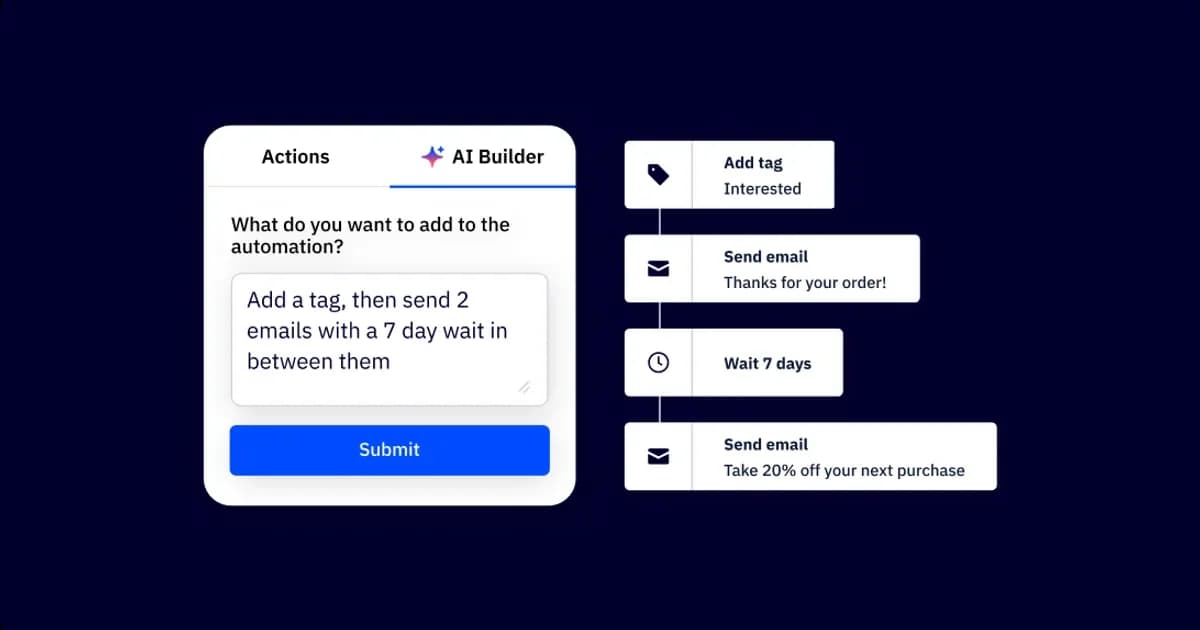
ActiveCampaign's AI engine can build an end-to-end nurture sequence from a plain language prompt, with triggers, actions, and conditions already set. Motrain used personalized trial nurture to lift its conversions, and you can read the Motrain story for the details.
How do you write nurture emails for every stakeholder?
One email rarely speaks to every stakeholder in a deal, so write for each role separately.
Each role needs something different from your email:
- Executives: business outcomes and strategic fit.
- End users: ease of use and day-to-day wins.
- Technical evaluators: integrations, security, and setup effort.
- Finance: cost, ROI, and payback period.
- Procurement: terms, compliance, and vendor reliability.
Tag contacts by role and branch nurture paths so each stakeholder gets relevant proof. Then build an account-level view of which roles are engaged and which are silent, so marketing and sales can see who's missing from the conversation.
How do you keep B2B deals warm when the buying committee goes quiet?
Keep deals warm by reading faint signals during the silence and acting on them. Committees often go quiet for weeks during evaluation, and most teams simply wait for a reply.
How can you tell a cold contact from one that's evaluating?
A contact who stops engaging with your emails after the first conversation is the early flag. Engagement recency, such as opened in the last three months versus the last year, gives you a simple segment to watch.
You might be getting pinged by the rep on LinkedIn to send you this article, like, ‘Hey, thinking of you,’ type of email, versus B2C, it’s just, ‘Hey, did you run out of this thing? It’s about time you buy it.’
You might be getting pinged by the rep on LinkedIn to send you this article, like, ‘Hey, thinking of you,’ type of email, versus B2C, it’s just, ‘Hey, did you run out of this thing? It’s about time you buy it.’
Fill the gaps with low-pressure touches between conversations, such as a rep sharing a relevant article with a note that they were thinking of that contact.
What are the faint signals worth tracking?
Watch for these four signals so you can respond early:
- Contacts re-engaging after a long silence
- New stakeholders from the same account opening emails
- Repeat views of pricing, security, or case study content
- Which messages and assets resonate by segment
Weigh clicks and repeat visits above opens, because some providers open email on the back end to check for spam, which can register as an open. Then act on each signal before the buyer says a word with a proactive segment, a targeted follow-up, or a sales alert.
What should you do with contacts who stay silent?
Re-engaging cold contacts has a cost. Sending beyond your engaged segment lowers open and click rates, so save it for an offer or a piece of content worth the dip. ActiveCampaign can flag contacts who aren't engaging so you can exclude them before a send. Remove contacts who stay silent after that, which protects deliverability.
How does Active Intelligence help during the quiet middle?
The long B2B feedback loop makes gut-feel optimization unreliable, because you may wait months to learn whether a message worked. Active Intelligence shortens that loop by reading patterns for you. Its best contribution is speed to value: it distills large amounts of data and connects the dots faster than a person can, and a marketer still checks that it's right. You can also ask from the outcome, such as the ROI of a campaign, and get analysis across campaigns instead of raw data.
These Active Intelligence capabilities support the quiet middle:
- Adaptive Memory learns how your account works over time, so guidance reflects your accumulated patterns instead of generic advice.
- Content Performance analysis surfaces the subject lines and messaging patterns driving opens and clicks, and flags assets ready to refresh.
- Industry Intelligence turns emerging trends and demand signals into campaign recommendations.
- Competitor Intelligence flags changes to competitor products, pricing, and messaging.
Business Goals turns a desired outcome into a connected strategy that links campaigns, automations, and forms and tracks progress in real time. That keeps nurture aligned to pipeline instead of one-off sends.
Connecting B2B email to your CRM and sales pipeline
Connecting email to your CRM lets engagement data inform tasks, deal stages, and rep follow-up. That connection turns a nurture program into pipeline, and it gives your B2B sales team context before every conversation.
Sales and marketing stay aligned when you follow these practices:
- Agree on a shared definition of a marketing-qualified and sales-qualified lead, written down and signed off by both teams.
- Set a service-level agreement for follow-up speed once a lead is handed off, for example within one business day.
- Build a feedback loop where reps flag lead quality so marketing can adjust scoring and content.
- Give reps context with every handoff, such as which emails and assets the contact engaged with.
- Pause or adjust marketing nurture while a rep actively works a deal, so buyers don't get mixed messages.
- Review pipeline together monthly to see which campaigns produce deals, not just leads.
Build the handoff around how reps already work. Reps skip a process that doesn't fit their workflow or whose value they haven't seen yet.
Often I have found sales reps don’t follow the marketing process, not because they don’t want to, but because it either doesn’t fit into their current workflow, or they haven’t yet understood the value.
Often I have found sales reps don’t follow the marketing process, not because they don’t want to, but because it either doesn’t fit into their current workflow, or they haven’t yet understood the value.
How should you set up lead scoring?
Start with simple scoring rules and refine them quarterly based on which scored leads actually closed. ActiveCampaign's Lead Scoring assigns points for site visits, email clicks, and content downloads, then routes the lead to the right rep once the contact crosses a threshold. Scoring earns its keep once leads outnumber the people available to call. A demo request always earns a call, and scores decide who to contact next.
Rank signals by closeness to purchase. A pricing page visit counts for more than an email open, and a contact sales visit counts for more than both. Treat those weights as illustrative, since each business sets its own score values. When a contact crosses your threshold, create a deal, assign it to the right rep, and create a follow-up task. Most of these steps are single automation actions, so add context in the deal notes and the task.
AI-driven Deal Scoring and Win Probability predict how likely each open deal is to close, based on deal attributes and contact engagement. They connect email behavior to pipeline likelihood, so sales can prioritize the deals worth chasing.
How do you prove email drove revenue?
Credit email for the actions it asks for directly, such as a trial start or a demo booking, and put UTMs in place so you can show where each one came from. Long cycles muddy the rest. Overlapping audiences and several touchpoints in the same month make it hard to see which one drove a conversion, so label revenue as influenced when email's action isn't the purchase. A before-and-after snapshot of pipeline can show the lift when attribution gets muddy.
Unless you have the breadcrumbs and UTMs in place, then it’s really, really, really hard to say specifically where and why, to prove that revenue back to email.
Unless you have the breadcrumbs and UTMs in place, then it’s really, really, really hard to say specifically where and why, to prove that revenue back to email.
Two ActiveCampaign reports help you make the case:
- Marketing Revenue Report ties purchases within seven days of an engaged send back to email, which suits shorter purchases.
- Attribution Reporting shows which campaigns and touchpoints drove conversions.
Engagement metrics live in ActiveCampaign, while revenue and conversion data depend on your integrations, so match the depth of your reporting to the stakes of the campaign.
The MCP connector for Claude and ChatGPT lets you query campaigns and contacts in plain language, which makes quick leadership answers easier to get. Analytics is the easiest place to start: you can move reporting into Claude or ChatGPT, blend in third-party data, and build custom dashboards that update as new data arrives.
What to look for in a B2B email marketing platform
The best B2B email marketing platforms help you read signals, not just send emails. Use this checklist, and weigh each item against how long your deals take to close.
Check these seven capabilities before you choose:
- CRM integration: engagement data should flow into deals, tasks, and rep follow-up.
- Automation depth: triggers and branches should match your real buying stages.
- Segmentation flexibility: you should be able to group by role, firmographics, and behavior.
- Lead scoring: points and thresholds should route leads to reps at the right moment.
- Reporting and attribution: you need to show which campaigns influence deals over months.
- Deliverability support: corporate inboxes need hygiene tools and sender guidance.
- Sales pipeline visibility: reps and marketers should see the same deal and engagement data.
ActiveCampaign covers each of these in one platform, and Active Intelligence adds the proactive layer that reads faint signals for you. B2B email wins by reading faint signals and acting before the buyer speaks.
Three shifts get you there: segment and personalize by role and behavior, nurture across every stage and stakeholder, and connect email to CRM and revenue.