Agentic AI AI DevEco JetBrains AI Research Survey
For the last three years, we’ve been measuring developer sentiment and attitudes toward the role of AI across the software development lifecycle via our Developer Ecosystem surveys and AI Pulse surveys.
The leap happening this year is striking. You can feel it in the air – especially in JetBrains Air – and see it in the numbers, too.
Earlier, we shared interesting insights into:
- the adoption trends for AI coding agents
- how agentic development is increasingly replacing manual coding
Readiness to delegate development activities to AI
Agents are empowering developers and enabling use cases that, just a year ago, were unimaginable to the vast majority of engineers.
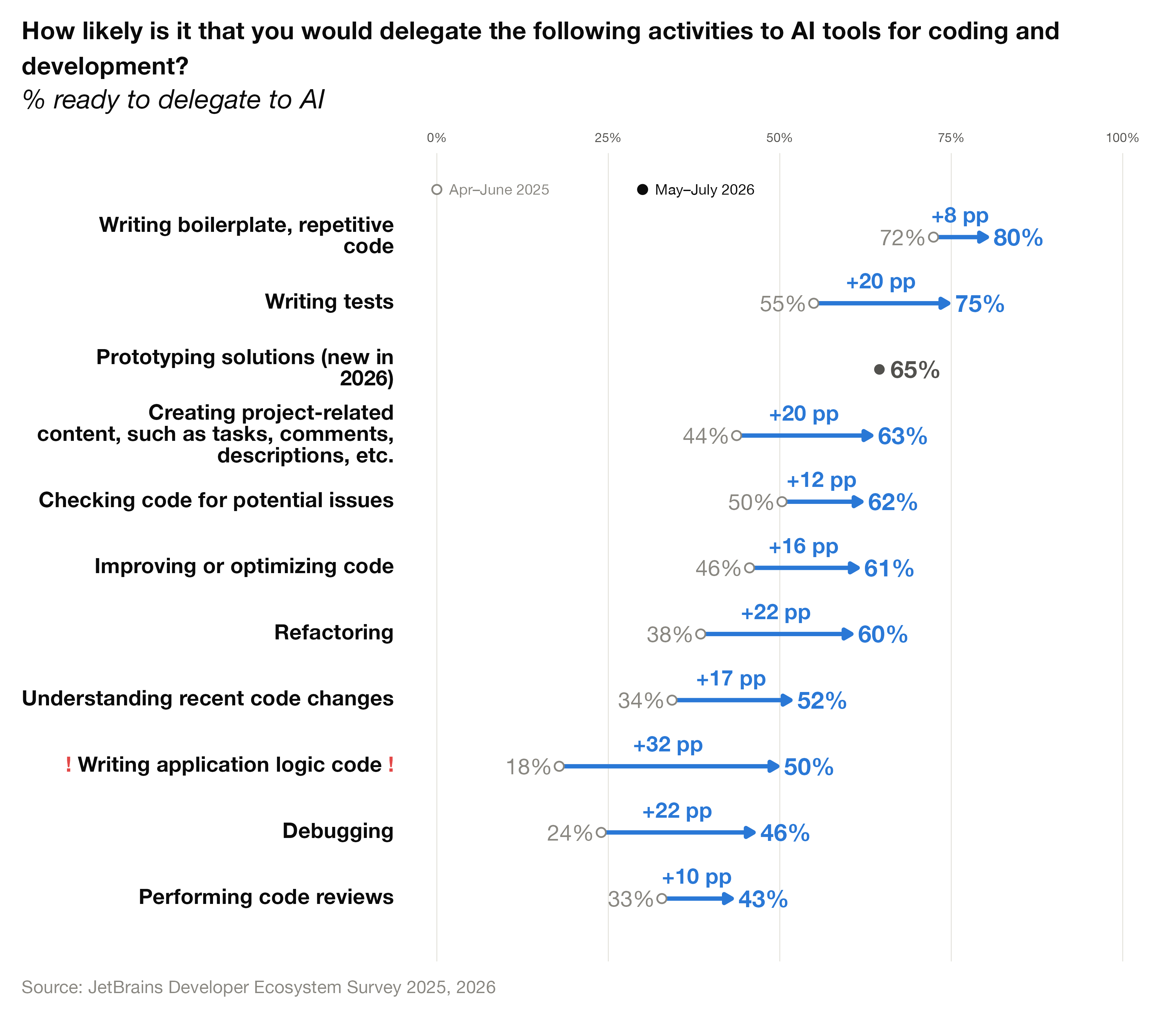
In May–July 2025, only 18% of developers were ready to delegate writing application logic code to AI. One year later, that number has jumped to 50% – nearly a threefold increase.
Test writing has also seen similar momentum, with the proportion of developers ready to delegate it to AI rising from 50% in May–July 2025 to 75% in 2026.
Delegation or refactoring tasks is another example, having grown from 38% to 60% over the same period.
There are, however, a couple of core activities that the majority of developers are not yet ready to delegate to AI:
- Code review – only 43% are ready to fully delegate code review to AI. This posture is also softening, though, up from 33% a year ago.
- Debugging – the majority (54%) are not yet ready to delegate debugging to AI. Still, the trend line is clear – down from 76% holding out last year – suggesting this preference may shift soon as agentic debugging improves.
Sentiment toward AI
Developer sentiment is also shifting rapidly. The vast majority (79%) believe employers will expect developers to be proficient with AI dev tools – up from 59% in June–July 2024.
A similar trend holds for expectations that AI tools will radically transform the software development job market.
Anxieties around the future of software jobs are growing, though they have not yet become the dominant view. Currently, 37% of developers believe that the adoption of AI coding will decrease demand for professional developers (compared with 28% in 2024). Nearly a quarter believe AI will eventually take over coding entirely and fully replace human developers – a sharp rise from just 8% in 2024.
Interestingly, though perhaps as expected, this outlook is more prevalent among heavy users of AI coding agents, where 37% agree that full replacement is possible. Those who rarely or never use agents remain much more skeptical.
We plan to share more insights on agentic development from the Developer Ecosystem Survey 2026 with the community soon.
Stay tuned and subscribe to JetBrains Research updates below!
Methodology notes
In this report, “developers” refers to respondents who reported being involved in coding or programming in any of the following job roles:
- Developer / Programmer / Software Engineer
- AI / ML Engineer
- DevOps Engineer / Infrastructure Developer
- Architect
- Data Scientist / Data Engineer / Data Analyst
- QA Engineer
Roughly 90% of the total sample falls into the Developer / Programmer / Software Engineer job category.
The Developer Ecosystem surveys are localized into eight languages: English, Spanish, Chinese, Japanese, Korean, German, French, and Brazilian Portuguese. To ensure accurate global representation, we apply regional response quotas based on developer population estimates from our Data Science team (details are available here).
The Developer Ecosystem Survey has been statistically reweighted to better represent the global developer population by region, employment status, programming language, and familiarity with JetBrains products. Read more about our weighting methodology here.