
Strategy
Competitive intelligence turns scattered signals into decisions. Get a 5-step process, best sources, tools, ethical lines, and more.
Key takeaways
- Competitive intelligence turns competitor signals into actionable business, product, and marketing decisions.
- The four core types are market, product, competitor, and consumer intelligence; CI can be strategic or tactical.
- A structured process (define priorities, collect data, analyze, distribute insights, iterate) turns raw information into action.
- Social listening tools like Lumen inside Hootsuite Social OS track mentions, sentiment, and actionable insights from social media.
What is competitive intelligence?
Competitive intelligence is the process of collecting and analyzing data about your competitors, industry, market, and customers to guide business decisions and strategy.
It involves gathering insights from multiple sources to understand trends, risks, and opportunities. It’s also often confused with related disciplines like market research and business intelligence, which we’ll untangle in the next section.
Bonus: Get a free social media sentiment report template to easily track audience sentiment over time.
Types of competitive intelligence
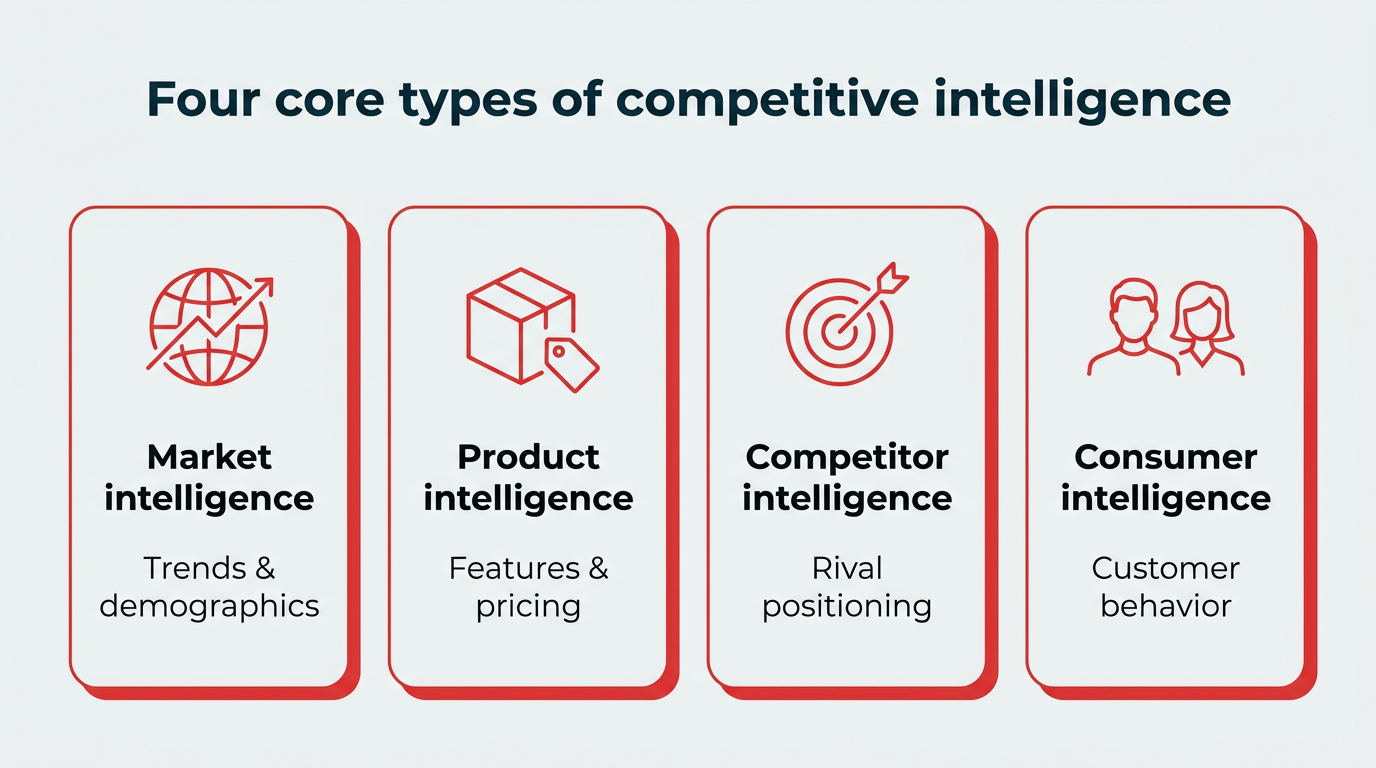
Competitive intelligence typically falls into four core categories. Most CI programs draw on all four, though the mix depends on what decisions you’re trying to support.
1. Market intelligence is data about factors outside your business, including:
- Demographics in your current regional market, or a new region you want to enter
- Current industry trends
- Current events and new technology
- Market research about size, growth rate, and other benchmarks
2. Product intelligence compares your products directly to those of your competitors. It looks at factors like:
- Features and performance
- Pricing strategy
- Availability (e.g., online vs retail-only, shipping regions, etc.)
- Reputation and reviews
Evaluating how your features stack up against a competitor’s product helps clarify differentiation and pricing strategy.
3. Competitor intelligence looks at how your rivals position themselves and operate in the market. This includes:
- Identifying key competitors in your space
- Analyzing their marketing strategies
- Conducting SWOT analyses (strengths, weaknesses, opportunities, threats)
- Evaluating competitor strategies around brand messaging and visual identity
4. Consumer intelligence provides valuable insights about your customers or target audience, including:
- Who they are (demographics)
- How customers found you, why they purchased, and other journey mapping data
- What your customers want in a product or service
- Shopping behavior, including digital and in-person behavior, as well as other competitors they shop at
Strategic vs. tactical competitive intelligence
Beyond the four types, it helps to know whether a piece of intelligence is meant to inform a long-term bet or a decision you’ll make this week. Strategic CI supports big, slow-moving decisions like market entry or acquisitions. Tactical CI supports the fast stuff: campaign tweaks, sales objection handling, content gaps.
Both matter. The difference is who consumes the insight and how quickly it expires.
Dimension
Strategic CI
Tactical CI
Time horizon
6 months to several years
Days to weeks
Typical questions
Should we enter this market? Which category is growing? Who might acquire whom?
Why did a competitor’s campaign spike? What objection is sales hearing this month?
Primary users
Executives, corporate strategy, product leadership
Marketing, sales, social, product marketing
Cadence
Quarterly or ad hoc deep dives
Continuous monitoring with weekly reviews
Example output
Market entry assessment, competitive landscape review
Battlecard update, campaign pivot, content brief
How is competitive intelligence different from market research, competitor analysis, and business intelligence?
Competitive intelligence is broader and more continuous than the disciplines it’s often confused with. Market research studies customers. Competitor analysis studies rivals. Business intelligence studies your own internal data. CI pulls from all three and adds interpretation, so leaders get a recommendation rather than a data dump.
Here’s how the four compare:
Discipline
Focus
Timeframe
Primary users
Example output
Competitive intelligence
External signals across competitors, market, and customers, interpreted for decisions
Ongoing and forward-looking
Strategy, marketing, sales, product
Briefing on a competitor’s likely next move, with a recommended response
Market research
Customer preferences, demand, and market sizing
Project-based and time-bound
Marketing, product, insights teams
Survey report on willingness to pay
Competitor analysis
A defined set of named rivals and how they operate
Point-in-time, refreshed periodically
Marketing, product marketing
SWOT or feature-by-feature comparison
Business intelligence
Your own internal performance data
Historical and real-time
Finance, ops, analytics, leadership
Revenue and pipeline dashboards
In practice, most teams run these together. Competitor analysis and market research feed your CI program, and business intelligence gives you the internal baseline you measure external signals against.
Why is competitive intelligence important?
Competitive intelligence matters because it shortens the gap between something changing in your market and your team responding to it. That speed shows up in a handful of concrete business outcomes:
- Faster decisions: When you already know how competitors price, position, and message, you don’t have to start from zero every time a decision lands on your desk.
- Lower risk: Regulatory shifts, supply chain issues, and reputational problems rarely arrive without warning signals. Catching them early buys you time to plan rather than react.
- Stronger positioning: Knowing exactly where rivals are weak lets you claim the ground they’ve left open instead of competing on the same three talking points.
- Better product bets: Customer complaints about competitors are free validation. They tell you what to build, and what not to bother building.
- A durable competitive advantage: One insight is useful. A repeatable process for spotting shifts before your competitors do is what actually compounds.
There’s a measurement benefit too. Brands that use social listening are more confident in their ability to prove social media marketing ROI to key stakeholders, which makes it easier to defend budget for the work. (This finding comes from the downloadable Hootsuite Social Media Trends 2026 report.)
How different teams use competitive intelligence
CI isn’t a marketing-only function, even though marketing often owns the tooling. The same insight tends to serve several teams at once, just framed differently.
- Marketing: Sharpens positioning, finds content and keyword gaps, and informs campaign timing based on what competitors are running.
- Sales: Turns competitor weaknesses into battlecards and objection-handling scripts reps can use on live calls.
- Product: Prioritizes the roadmap using recurring feature requests and complaints, including complaints aimed at competitors.
- Executive and strategy teams: Supports market entry decisions, partnership evaluations, and competitive landscape reviews.
What does the competitive intelligence process look like?
The competitive intelligence process runs as a continuous loop rather than a one-off project. Most teams follow five steps:
- Define your intelligence priorities
- Collect data from multiple sources
- Analyze and find patterns
- Distribute insights and take action
- Monitor and iterate
Here’s what each step involves.
Define your intelligence priorities
Start with the questions your business actually needs answered, not the data you happen to have access to. A common framework is to set key intelligence topics (the broad areas leadership cares about, like pricing pressure or a new entrant) and then break each into key intelligence questions you can realistically answer.
Tie each priority to a decision. If no one would act differently based on the answer, it’s probably not a priority.
Collect data from multiple sources
Collection spans social conversations, search data, competitor-owned content, public filings, and your own sales and support teams. The goal is coverage without noise: enough sources to catch signals early, few enough that someone can actually review them.
We break down the highest-value sources in the next section.
Analyze and find patterns
Competitive intelligence is only valuable when you can find patterns from all that data. Four patterns are worth watching closely: mention volume, engagement spikes, demographic shifts, and pricing moves.
Track mention volume by week. Pay attention to how many brand mentions you get each week. This gives you a baseline to work with. While ebbs and flows are common, especially if your business is seasonal, big variations can point to something bigger going on. For example:
- A 20% lift in mentions paired with positive sentiment could indicate successful media coverage or influencer exposure. Consider riding the momentum with additional content or paid support.
- A spike in negative mentions may signal a mounting PR issue. Spotting this early allows your team to respond before it escalates.
The key isn’t just tracking spikes, but understanding the why behind it. That context is what allows teams to pivot and make confident, data-driven decisions.
Notice engagement spikes. When engagement suddenly increases, look beyond surface metrics. Is a piece of content going viral because the audience is excited about it? Grateful for the cool hack? Confused and asking clarifying questions?
Understanding why something captures your audience’s attention gives you a blueprint for holding their attention with similar content or messaging. Likewise, if a competitor is experiencing a surge in engagement, investigate what changed. Did they launch something new? Announce pricing changes? Shift messaging?
To spot true spikes in engagement, you need to know what your average engagement rate is, or the average for your industry if you’re comparing your brand to another. For instance, our research found the overall average engagement rate of Instagram is 3.5%, but only 1.8% on X.
Pro tip: See all our current data on the average engagement rates by industry and platform.
Gather demographics. Competitive intelligence tools can track demographic data such as age, location, language, and interests over time. Look for patterns like a growing audience segment, increased engagement in a new geographic region, or shifts in buyer profiles. These trends can signal emerging opportunities or gaps in your current messaging.
Keep up with pricing trends. Does Competitor A always have a big quarterly sale? Has Competitor B just switched from a one-time purchase to a subscription model? Has Competitor C raised their prices? And, more importantly, how do all their customers feel about these changes?
Look for customer feedback in forums and conversations across social media to uncover competitive positioning gaps. For instance, if customers consistently compare you as “more expensive,” you may need to highlight your differentiators more. That insight can translate directly into social media content and marketing campaigns your marketing team can start ASAP.
Distribute insights and take action
An insight nobody sees has no value. Decide upfront where CI lands: a shared dashboard, a weekly briefing, battlecards in your sales enablement library, or alerts pushed into the Slack or Teams channel where decisions actually get made.
Match the format to the audience. Executives want a short recommendation. Sales wants a one-page comparison they can skim before a call. Social and content teams want the raw conversation so they can spot language to borrow.
Hootsuite Social OS helps here through Wisdom, where you can ask competitive questions in plain language and get cited answers drawn from your connected social and listening data, so the person who needs the insight doesn’t have to build a report to get it.
Monitor and iterate
Set a cadence and stick to it. Review tactical signals weekly, run a deeper strategic assessment quarterly, and prune priorities that stopped driving decisions. A CI program that never changes its questions is usually answering last year’s.
What are the best sources for competitive intelligence?
The best competitive intelligence sources combine public external signals with internal knowledge your team already holds. Here’s where most of the useful material comes from:
- Social media and social listening: Real-time conversations about your brand, competitors, and category, including complaints competitors haven’t addressed.
- Customer interviews and win/loss analysis: Direct explanations of why deals closed or didn’t, and which competitor came up.
- Competitor websites, pricing pages, and help docs: Product changes, positioning shifts, and feature launches usually show up here first.
- SEO and search data: Which keywords competitors rank for, which they’re bidding on, and where they’ve left gaps.
- Press releases, news, and earnings calls: Publicly stated priorities, investments, and market commentary.
- Forums and review sites: Communities like Reddit and review platforms where people compare options candidly.
- Internal CRM and sales team knowledge: Your reps hear objections and competitor claims daily. Ask them regularly.
- Job postings and hiring signals: A sudden cluster of roles in one function often previews where a competitor is heading next.
What role does social media play in competitive intelligence?
Social media plays a key role in competitive intelligence by providing real-time data about competitors, customers, and market trends. The social listening market alone is projected to reach $22.61 billion by 2030. Your competitors are active there, and so are their customers.
Social listening turns those conversations into insights. Instead of tracking surface metrics like likes and comments, social listening helps you understand sentiment, brand reputation, and emerging trends.
For example, if customers regularly complain about slow response times from Competitor A, you can position your five-minute response guarantee as a differentiator.
Use social listening to:
- Understand why customers choose your competitors
- Track your reputation
- Identify the main emotions people feel about your brand, a competitor, or a topic with AI sentiment analysis
- Monitor brand names, keywords, and industry topics across social platforms
- Identify content gaps and new market opportunities
- Prove your social ROI with detailed analytics and customizable reports
How can competitive intelligence shape your business strategy?
Competitive intelligence can shape your business strategy by improving segmentation, positioning, product development, risk management, and trend forecasting. This gives your team the data they need to make faster, more confident decisions.
Let’s take a closer look at where competitive intelligence has the greatest impact.
Audience segmentation
Competitive intelligence gives you the data to understand your audience better.
By analyzing competitors’ messaging, engagement, and customer conversations, you can narrow down:
- Which segments they prioritize
- What language resonates
- What problems their audience cares about
Tools like Lumen inside Hootsuite Social OS and SEMrush help you understand not just who your audience is, but what motivates them.
From there, identify segments your competitors overlook, review competitor websites and social feeds quarterly to analyze the language they use, and align your content strategy with what actually motivates people.
#1 Easy Social Listening
Brand mentions, trending topics, and sentiment at your fingertips. Enhance your social strategy with the insights that matter.
Start your free trial
Identifying market gaps
Market gaps often pop up in repeated customer questions and feedback. When people consistently ask for a product, feature, or solution, that pattern may signal an opportunity.
Forums, comment sections, and online reviews are goldmines for these signals. If multiple people express the same frustration or “wish this existed” idea, it’s worth investigating.
Source: r/photography
To act on this, track recurring requests or complaints across channels to validate demand. If a gap appears consistently, explore whether it points to a positioning opportunity, a new feature, or an entirely new offering. Scan sources beyond social media too, including podcasts, websites, and video mentions.
And remember: your sales teams are a treasure trove of information. Ask them about common customer needs and pain points, then use those insights to revamp sales enablement materials and messaging.
Identifying competitor weaknesses
Competitor weaknesses rarely show up as one dramatic failure. They appear as consistent gaps.
Use competitive intelligence software to uncover:
- Gaps in content or ad strategies: See if competitors are targeting the wrong keywords. Or, analyze their paid campaigns to uncover targeting opportunities.
- Customer feedback: Identify patterns in customer reviews, especially negative ones, to spot recurring complaints about features, response times, or product quality.
- Social media performance: Use the benchmarking features in Hootsuite Social OS to track competitor audience growth and engagement over time.
- SEO ranking: Use tools like Ahrefs, Moz, SEMrush, and others to track your competitors’ SEO rankings. Identify ways to beat them for relevant keywords, or uncover keywords they’re overlooking. The same goes for social SEO.
Once you’ve found a weakness, position your strengths directly against it. These insights can also be turned into internal battlecards for marketing and sales teams, or used to redirect spend toward the channels and keywords competitors have neglected. Audit competitors regularly rather than only when something goes wrong.
Risk management and crisis detection
Competitive intelligence isn’t just about finding opportunities, it’s also about reducing surprises.
Markets shift. Regulations change. Public sentiment evolves. New brands emerge in the competitive landscape. The organizations that spot these shifts early have more time to respond strategically.
Listening tools scan the web and social media to give you early warning signs into:
- Increased attention around regulatory or policy changes
- Supply chain disruptions
- Emerging technologies reshaping customer expectations
- New competitors gaining traction
An easy way to stay on top of potential PR risks is tracking your brand sentiment over time with Lumen inside Hootsuite Social OS. Know with one glance if trouble could be brewing, or, much more excitingly, if a great review is going viral.
Product roadmapping
Customer feedback, especially about competitors, is strategic gold. It’s especially valuable for product marketing teams responsible for positioning, messaging, and making data-driven decisions around strategy.
Listening to what customers are saying is like having an automatic product roadmap made for you. After all, customers are constantly telling you what they value, what frustrates them, and what they wish existed.
As you sort through feedback, pay attention to:
- Features customers love
- Recurring complaints
- Trade-offs customers are willing to make
That feedback becomes even more powerful when you analyze not just your own reviews and conversations, but those of your competitors. What do they love about their products that yours don’t have? How can you make your products better, more innovative, or more economical?
Consider the example below. The customer loves the backpack’s design but complains that the zippers are unusually loud, with multiple commenters agreeing. A few comments alone don’t justify redesigning the product. But if similar feedback appears repeatedly, it can be a sign to improve on product quality.
Source: r/ManyBaggers
Identify feedback patterns across social media and forums, validate new product developments before investing heavily, and prioritize roadmap items based on what customers keep asking for.
Trendspotting
From the latest TikTok meme to market trends, spotting trends is much faster and easier with competitive intelligence tools. Forrester’s research shows these platforms are now expanding beyond monitoring into trend forecasting and prediction.
You don’t need to jump on every trend, but if it makes sense for your brand, it can inspire fresh marketing content.
A well-known example is brands creating their own spin on Spotify’s annual “Wrapped” campaign. The best takes honor the ethos of Spotify’s look while being relevant to their own products and services, like how Beyond Type 1 used it to raise awareness of Type 1 diabetes:
Source: Beyond Type 1
Use Lumen to search current trends on any topic and monitor what people are saying about you over time. Then evaluate whether a trend aligns with your brand identity, put a unique spin on it instead of simply copying it, and watch how competitors execute their own trend-based campaigns.
Benchmarking
Benchmarking provides context. It doesn’t define your success, but it helps you measure progress.
Understanding how you compare to competitors clarifies where you’re leading, where you’re lagging, and where incremental gains would make the biggest impact.
Some comparisons are qualitative, such as content quality or brand positioning. Others are measurable:
- Engagement rates across platforms
- Share of voice: Visibility in category conversations
- Search rankings for high-value keywords
- Website traffic share
- Pricing strategy
- Customer service response times
Remember: Benchmarking is only meaningful when you compare against companies of similar size, industry, and platform context.
You’ll likely need a combination of competitive intelligence tools to find these benchmarks. Use Hootsuite Social OS’s benchmarking and competitive analysis features to measure your social performance against competitors and industry averages for organizations your size.
Add SEO tracking, website traffic research, and other specialist tools for a complete competitive intelligence solution. Use the benchmarks you gather to set realistic, data-informed performance goals and align KPIs with strategic priorities instead of vanity metrics.
Is competitive intelligence legal and ethical?
Competitive intelligence is legal when it relies on publicly available information and honest research methods. The distinction matters: gathering intelligence and stealing trade secrets are not the same activity, and confusing the two exposes your organization to real legal liability.
Practices that are generally accepted:
- Reviewing competitor websites, pricing pages, job postings, and published documentation
- Monitoring public social conversations, reviews, forums, and news coverage
- Reading public filings, earnings calls, and patent records
- Interviewing customers and prospects who consent to the conversation
- Attending public trade shows and reading published analyst research
Practices that cross the line:
- Misrepresenting who you are or who you work for to obtain information
- Acquiring or using trade secrets, confidential documents, or stolen credentials
- Inducing a competitor’s current or former employee to breach a confidentiality agreement
- Social engineering, unauthorized system access, or recording people without consent
Many practitioners follow the code of ethics published by the Strategic and Competitive Intelligence Professionals association, which sets a clear standard: identify yourself accurately, respect confidentiality obligations, and comply with applicable laws. If a collection method would embarrass your company if it were reported publicly, treat that as a stop signal and check with legal.
What are the risks and challenges of competitive intelligence?
Even a well-run CI program has failure modes. Knowing them upfront makes them easier to design around.
- Data overload: Collecting everything produces noise, not insight. Without defined priorities, teams spend more time gathering than deciding.
Competitive intelligence tools for 2026
Tool
Best for
Ahrefs