Rather than replacing entire banking platforms, many institutions are introducing new capabilities alongside proven core systems, modernizing incrementally to reduce risk, accelerate delivery, and respond faster to changing customer and market demands. As a result, banking architectures are becoming increasingly distributed, composable, and AI-enabled.
But in doing so, an important question emerges: can composable capabilities deliver the performance, scale, and resilience traditionally associated with core banking systems? The Temenos Performance Benchmark 2026 was designed to answer that question.
Conducted in collaboration with Microsoft Azure, the benchmark tested a production-scale banking environment where integrated core banking, composable capabilities, payments, microservices, and AI-powered workloads operated within a single architecture.
Unlike previous benchmarks focused primarily on maximum throughput, this year’s benchmark examined how modern banking ecosystems perform under conditions that more closely reflect how banks are evolving today, with workload volumes representative of a typical mid-sized bank.
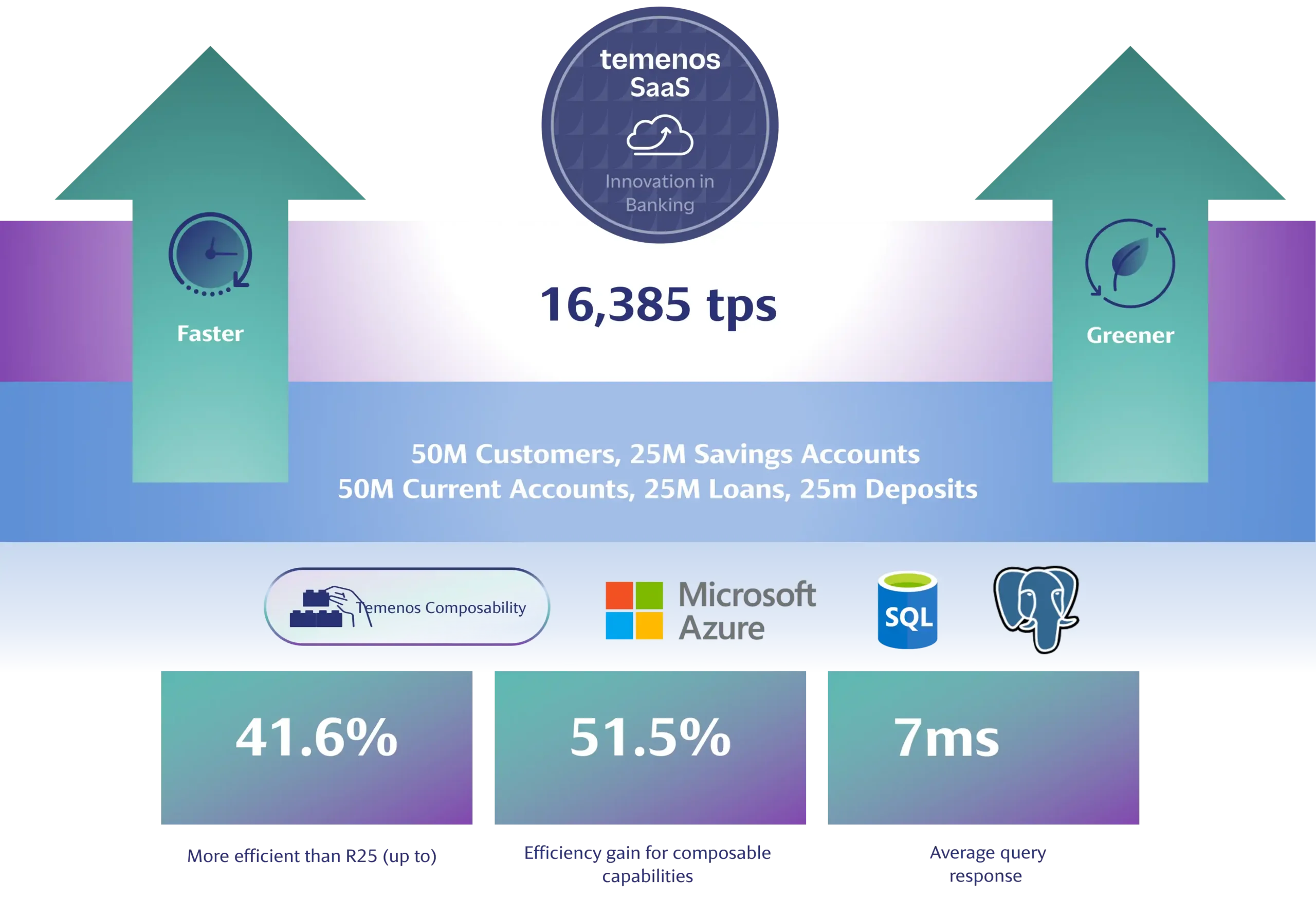
We achieved a sustained throughput of 16,385 transactions per second (TPS), with Temenos Composable Deposits delivering 2,109 TPS. More importantly, the findings reinforce that integrated core banking and composable banking are not competing models. They can coexist within a single architecture, enabling banks to combine the proven stability of integrated core systems with the flexibility and agility needed to innovate faster.
For banks pursuing modernization, this demonstrates that they do not need to choose between stability and innovation to move forward. Instead, they can introduce new capabilities and leverage modern, cloud-native technologies where they deliver the greatest business value, without disrupting existing operations.
Supporting AI workloads at scale
The benchmark also highlights the growing role of AI in banking. As AI moves from experimentation to production, banks need confidence that AI-powered services can operate reliably at scale. To test this, we incorporated Temenos Copilot for Core into this year’s benchmark.
The results demonstrate that AI can scale alongside core banking operations. Workloads sustained 252 requests per second while maintaining response times below 50 milliseconds, showing that AI-powered interactions, from retrieving customer information to generating operational insights, can operate without becoming a performance bottleneck.
Users receive near real-time responses while the platform simultaneously processes high volumes of transactions, payments, and enquiries.
The benchmark tests the efficiency of the latest Temenos R26 release, including composable solutions.
Taken together, these results demonstrate a new model for banking modernization. Integrated core banking services, composable solutions, cloud-native technologies, and AI-powered experiences should not be viewed as separate initiatives. As the benchmark shows, they can work together within a unified architecture designed for both stability and innovation.
The 2026 Performance Benchmark demonstrates that banks can modernize incrementally, introducing composable and AI-powered capabilities alongside proven core banking services without compromising performance, resilience, or scale. Composable banking is not the destination. It is the modernization mechanism.