Demand for advanced chips is rising. The processes to build them are getting more complex. And the margin for error is shrinking.
For engineers, understanding how a process change will behave, how a material will interact with a new step, how a defect maps back to a root cause are critical, challenging steps in semiconductor manufacturing — and these analyses can take days. Physical experiments on a fab line are slow and expensive. A wrong call on yield or process quality has real consequences.
AI is transforming semiconductor manufacturing, impacting what engineers can do — and how fast.
Accelerated computing shortens simulation time, allowing engineers to evaluate more alternatives before committing to physical trials.
Physics-based AI helps engineers predict process behavior without running a full simulation every time.
AI agents handle sequences of engineering tasks that once consumed hours.
And digital twins let teams test changes in a virtual environment before committing to physical trials.
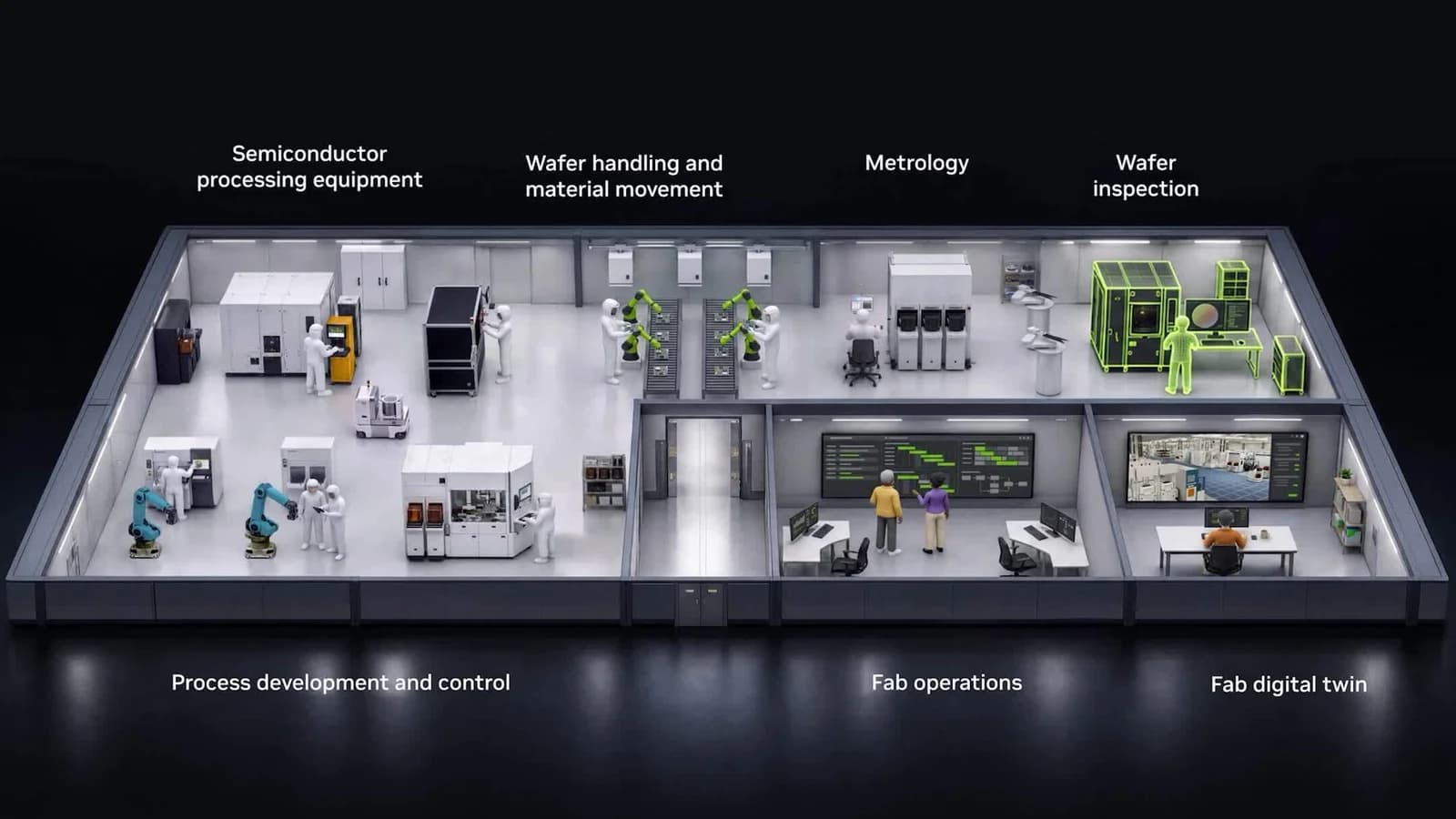
Together, these capabilities describe an AI-defined fab: a semiconductor manufacturing factory where AI helps engineers optimize processes, catch problems earlier and make better decisions across the full manufacturing chip lifecycle. Engineers direct the work and make decisions based on their expertise while spending less time waiting for answers.
Shorter Simulation Cycles Change What Engineers Can Explore
Accelerated computing doesn’t just speed up individual calculations — it changes how many alternatives engineers can test before committing.
Multiphysics simulations model interactions among physical effects, such as heat transfer, electrical behavior and mechanical stress.
Using the NVIDIA cuDSS library, multiphysics software provider COMSOL is accelerating such simulations for semiconductor manufacturing by up to 10x. This helps engineers optimize equipment and processes, compare alternatives and decide which changes to test physically.
Applied Materials and NVIDIA are collaborating to accelerate atomic-scale materials discovery and process development. By integrating NVIDIA cuDSS, Applied’s Ginestra simulation platform runs up to 10x faster than CPU-only approaches. And with NVIDIA PhysicsNeMo, Applied’s ACE+ multiphysics platform delivers topography simulations up to 35x faster.
In some cases, acceleration doesn’t just shorten the calculation — it enables it altogether. Computational lithography — which defines how circuit patterns are printed onto silicon — involves calculations too intensive to complete on CPU at production scale. Siemens is integrating NVIDIA cuLitho into its Calibre lithography software, delivering up to 17x acceleration on key simulation workloads. That expands what engineers can verify before a wafer goes to print.
As such, faster calculations can help researchers explore material behavior and reaction pathways that influence next-generation semiconductor processes.
Predicting Process Behavior Without Running Every Simulation
In addition to accelerating simulations, AI trained on physics can predict how materials and processes will behave — without running a full simulation each time.
The payoff is most visible in complex calculations that are expensive even on accelerated hardware.
Plasma — the electrically charged gas used in semiconductor etch processes — is one example. Modeling plasma behavior requires solving equations that capture how electrical, chemical and thermal processes interact, making repeated simulation costly. Lam Research demonstrated that the NVIDIA PhysicsNeMo framework can predict plasma behavior in milliseconds, compared with days for a full simulation — giving engineers a faster way to explore process conditions without rerunning the full model each time.
Agents Handle the Steps Between Decisions
Engineers turn analyses into decisions — revising a design, investigating a test failure, adjusting a production process and more.
AI agents can help carry out the steps between those decisions.
Evaluating which AI model to apply to a given task is one example: a sequential, manual process that can consume hours on the test floor.
Advantest is using NVIDIA NeMo Switchyard AI agents to automate that selection, reducing response times from hours to minutes.
Testing Factory Changes Before They Reach the Line
Digital twins let teams simulate equipment configurations, layouts and process changes in a virtual environment before committing to physical trials. This reduces experimentation costs, especially as fabs become more complex and the stakes of a wrong change get higher.
Applied Materials uses NVIDIA Omniverse libraries to build physically accurate digital twins of entire fabs. Teams can simulate material movement, identify bottlenecks and evaluate layouts and operating strategies — extending virtual experimentation beyond individual processes to how the factory works as a whole.
The Connected Loop
The future of semiconductor manufacturing lies in connecting these capabilities: using production data to inform models and models to evaluate changes, then bringing those findings back to the engineers making production decisions.
That’s the promise of the AI-defined fab: where AI helps people learn from each production cycle and act on that knowledge sooner.
Explore how NVIDIA is working with semiconductor leaders across the chip lifecycle.