Executive summary
The rapid adoption of Azure Cloud platforms has transformed how enterprises design, deploy and operate databases. While infrastructure has evolved toward elasticity, scalability and cloud native automation, database operations continue to rely heavily on reactive processes, threshold-driven alerts and manual intervention.
In today's digital environment, database reliability, performance, availability and cost optimization are no longer operational concerns. They have become business-critical enablers that directly influence customer experience, operational continuity and organizational agility.
However, modern Azure database environments continue to face growing challenges, including operational complexity, alert fatigue, increasing database sprawl, rising DBA workloads and a lack of contextual intelligence. Traditional monitoring platforms can identify symptoms but often fail to explain root causes or recommend effective remediation actions.
To address this gap, organizations need to shift from reactive to intelligent, autonomous operations.
This blog introduces an AI-driven Auto-Healing solution, a closed-loop operational framework designed to continuously detect, diagnose, predict and remediate database issues with minimal human intervention.
By combining AI-driven anomaly detection, semantic knowledge retrieval, automated remediation, predictive intelligence and policy-driven governance, the solution transforms database management into a resilient, self-learning and self-healing operating model.
Why database operations need to evolve
Azure Cloud adoption has accelerated the modernization of enterprise applications and databases. However, operational practices have not evolved at the same pace.
Most database teams encounter the following challenges that impact business performance and continuity:
- Reactive operations model: Many database operations teams still rely heavily on alerts and manual intervention to identify and resolve issues. As a result, problems are often detected only after they have already impacted application performance or end-user experience, leading to slower response times and prolonged resolution efforts.
- Alert fatigue: Modern database environments generate large volumes of alerts, many of which are repetitive or non-critical. This creates alert fatigue among operations teams, making it harder to distinguish genuine critical incidents from routine notifications and increasing the risk of important issues being overlooked.
- Operational complexity: Azure database environments are becoming increasingly complex due to dynamic workloads, multi-tenant architectures and growing configuration requirements. Managing this expanding ecosystem while maintaining consistent performance and reliability places significant pressure on database operations teams.
- DBA resource overload: Skilled database administrators often spend a considerable amount of time addressing repetitive operational tasks such as monitoring, troubleshooting and routine maintenance. This reduces the time available for strategic initiatives, optimization efforts and modernization projects that deliver greater business value.
- Lack of contextual intelligence: Traditional monitoring tools can identify that an issue exists, but often provide limited insight into why it occurred or how it should be resolved. Without contextual intelligence, teams must rely on manual analysis and individual expertise, which increases troubleshooting effort and delays remediation.
These challenges collectively increase operational risk while limiting an organization's ability to realize the benefits of Azure-based database platforms fully.
What is an AI-driven Auto-Healing solution?
The AI-driven Auto-Healing solution is a next-generation operational framework that enables databases to self-detect, self-diagnose, self-remediate and continuously learn from operational outcomes.
Unlike traditional monitoring solutions that stop at detection, auto-healing establishes a closed-loop system where every stage of the operational lifecycle works together:
- Detect anomalies
- Diagnose root causes
- Retrieve proven resolutions
- Execute corrective actions
- Validate outcomes
- Learn from results
By continuously cycling through these activities, database operations evolve from reactive management into proactive and predictive resilience.
Key features of the Auto-Healing solution
Intelligent anomaly detection
- Detects abnormal patterns beyond static thresholds
- Identifies early indicators of performance degradation
- Utilizes AI-driven pattern recognition
Knowledge-driven decision engine
- Uses historical incidents, runbooks and postmortems
- Identifies proven remediation approaches
- Selects actions based on prior effectiveness
Autonomous remediation
- Executes corrective actions automatically
- Supports query optimization, scaling, storage management and performance tuning
- Significantly reduces Mean Time to Resolution (MTTR)
Policy-based governance
- Applies risk-based operational controls
- Enforces approval workflows where required
- Maintains compliance and operational safety
Predictive intelligence
- Detects precursor patterns associated with future incidents
- Anticipates capacity and performance risks
- Enables incident avoidance rather than incident response
Continuous learning
- Captures outcomes from every remediation cycle
- Improves retrieval accuracy over time
- Strengthens predictive capabilities through operational experience
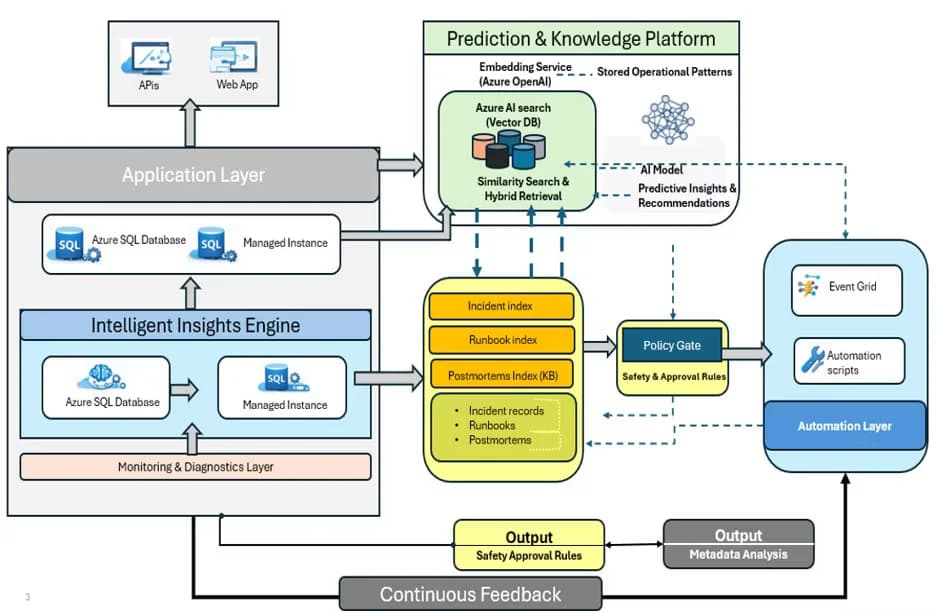
Architecture of the Auto-Healing solution
Achieving autonomous database operations requires more than monitoring and automation. It requires a layered intelligence architecture where operational telemetry is progressively transformed into contextual understanding, governed decision-making, automated execution and continuous learning.
Each layer plays a distinct role, collectively creating a closed-loop operational system capable of detecting, understanding, resolving and preventing database incidents at scale.
Layer 1: Monitoring and diagnostics
The monitoring and diagnostics layer provides continuous visibility into the database environment by capturing telemetry on performance metrics, query behavior, resource utilization and system health. It correlates data from multiple sources, such as logs, metrics and events, to detect anomalies and trigger incident signals, ensuring that deviations from normal behavior are identified early with sufficient diagnostic context for downstream analysis.
Layer 2: Insight and diagnosis
The insight and diagnosis layer transforms raw telemetry into meaningful intelligence by analyzing detected anomalies using rule-based logic and AI-driven models. It enriches incidents with root-cause hypotheses, impact assessments and contextual understanding, enabling precise problem identification. This layer bridges detection and decision-making by converting signals into actionable insights that guide accurate and efficient remediation.
Layer 3: Prediction and knowledge platform
The Prediction and Knowledge Platform functions as the intelligence core of the auto-healing system, leveraging Azure AI Search and OpenAI embeddings to semantically understand incidents and build an operational memory through structured stores of incidents, validated runbooks and postmortem insights. When a new issue arises, it performs hybrid retrieval to identify the most contextually relevant past incidents and recommends remediation actions that have proven effective in similar scenarios, ensuring decisions are grounded in real outcomes rather than theoretical assumptions.
Layer 4: Automation and remediation
The automation and remediation layer translates intelligence into action by orchestrating policy-approved fixes via Azure Functions and executing them via pre-validated PowerShell or Python runbooks. It supports a wide range of operational interventions, including query optimization, scaling, session handling and maintenance activities, with every action dynamically parameterized to match the specific context, thereby ensuring precision, minimizing risk and avoiding generic or potentially harmful remediations.
Layer 5: Policy Gate
The Policy Gate introduces governance and control by enforcing a risk-based execution model that determines how actions are applied across different scenarios. Low-risk actions can be executed autonomously, medium-risk actions proceed with notifications and high-risk changes require explicit approval. At the same time, all activities are comprehensively logged to maintain a full audit trail. This layer ensures that automation operates within enterprise-grade compliance and trust boundaries without compromising operational speed.
Layer 6: Continuous optimization loop
The continuous optimization loop layer enables the system to evolve into a self-learning platform by continuously capturing the effectiveness of each remediation and feeding those insights back into the knowledge base. Over time, it refines runbook rankings, improves detection accuracy and strengthens predictive capabilities, allowing the system to transition from reactive issue resolution to proactive and predictive operations driven by collective learning from all past incidents.
How the Auto-Healing solution overcomes key database management challenges
- Reactive operations: AI-Driven Auto-Healing enables real-time anomaly detection and instant remediation, eliminating delays caused by manual intervention and significantly reducing MTTR.
- Alert fatigue: AI-based filtering and contextual intelligence ensure that only high-priority, actionable incidents are surfaced, reducing operational noise and improving focus.
- High DBA Workload: Routine activities such as tuning, scaling, troubleshooting and performance correction are automated through intelligent runbooks, enabling DBAs to focus on higher-value initiatives.
- Operational complexity: Centralized intelligence and unified visibility simplify operations across distributed Azure database environments.
- Operational drift: Continuous monitoring and feedback mechanisms automatically identify and correct deviations from desired performance baselines.
- Cost and utilization challenges: AI-driven optimization enables efficient resource utilization, minimizing over-provisioning while maintaining performance objectives.
- Lack of root cause visibility: Historical incidents, validated runbooks and postmortem analyses enable precise root-cause identification and recommendation of proven remediation actions.
- Delayed incident resolution: Automated remediation orchestration accelerates corrective action execution, improving availability and reducing downtime.
- Inconsistent performance: Predictive analytics identify degradation trends before they impact services, enabling proactive intervention and workload optimization.
- Security and governance risks: The Policy Gate enforces risk-based automation, ensuring safe execution, auditability and compliance with organizational standards.
Implementation challenges and mitigations
No transformative operational capability can be implemented without challenges. Recognizing potential implementation barriers and proactively addressing them through architectural and organizational measures is a hallmark of a mature solution design.
The following section highlights the key challenges organizations may encounter when adopting AI-driven database automation and the built-in mitigations designed to address them:
The effectiveness of the system is fundamentally dependent on the quality of its inputs. Gaps in telemetry coverage, inconsistent metric granularity or issues with Log Analytics workspace configuration can lead to incomplete data, reducing the accuracy of knowledge retrieval and decision-making.
Mitigation: A telemetry health validation module continuously monitors data quality, identifies coverage gaps and automatically escalates configuration issues. The deployment process also includes a telemetry audit phase before live automation is enabled.
A new deployment begins with a limited knowledge repository. As a result, the system cannot immediately retrieve historically effective runbooks because sufficient organizational data has not yet been accumulated and encoded. Initial recommendations may therefore be less refined than those generated after several months of operational learning.
Mitigation: A pre-seeded knowledge base built from anonymized industry incident patterns. During onboarding, client-specific incident records, operational documentation and existing runbooks are ingested to accelerate knowledge maturity and improve recommendation quality.
Retrieval similarity scores above the defined thresholds do not always guarantee that a recommended runbook is appropriate for a new or previously unseen incident variant. Overconfident automation in such scenarios may introduce remediation risks.
Mitigation: Confidence thresholds can be configured based on action type and risk profile. Recommendations that fall below the defined threshold automatically revert to DBA advisory mode, where the system presents the most relevant recommendation along with its confidence score rather than executing autonomous actions. Human review then helps enrich the knowledge base and improve future decision accuracy.
Organizations vary considerably in their tolerance for autonomous database operations. Without clearly defined governance policies, excessive automation may introduce risk, while overly restrictive controls may limit the solution's value.
Mitigation: The Policy Gate includes a default risk-classification matrix covering more than 40 common action types. This matrix is reviewed and customized in collaboration with the client's IT governance and compliance teams during implementation, ensuring that automation boundaries reflect organizational risk tolerance and regulatory requirements.
Database administrators who have built their expertise around manual operational processes may initially perceive autonomous systems as a threat rather than an enabler. Reluctance to trust AI-driven recommendations can slow adoption and lead to parallel processes that bypass automation.
Mitigation: The framework is designed with explainability as a core principle. Every automated decision is accompanied by a clear rationale, including the historical incidents retrieved, the effectiveness scores that informed the recommendation and the reason the Policy Gate approved the action. This transparency helps position the system not as a black box, but as a trusted operational partner that clearly demonstrates how decisions are made.
Conclusion: Why Auto-Healing is the ideal foundation for Azure SQL adoption
Azure SQL Database offers the scalability, elasticity and operational flexibility required to support modern enterprise workloads. However, realizing these benefits at scale requires an equally modern operational model capable of managing increasing complexity, dynamic workloads and growing operational demands.
The AI-driven Auto-Healing solution provides this foundation through a closed-loop framework that integrates intelligent monitoring, contextual diagnosis, knowledge-driven decision-making, automated remediation, predictive analytics, governance and continuous learning. By combining autonomous operations with policy-driven controls, the solution enables organizations to improve availability and resilience, reduce operational overhead, optimize cloud utilization, strengthen governance and compliance and accelerate modernization initiatives.
More importantly, the solution transforms operational knowledge into a reusable enterprise asset. Every incident, remediation action and outcome continuously enriches the knowledge platform, enabling more accurate recommendations and increasingly effective interventions over time. As a result, database operations evolve from reactive administration and incident response to proactive, predictive and ultimately autonomous resilience.
For organizations pursuing Azure SQL modernization, the AI-Driven Auto-Healing solution offers a practical path to intelligent database operations, transforming technical objectives of reliability and operational excellence into strategic business capabilities.