11-09-2026 5 min read
- Strong demand shows: AI has arrived in business
- Initial expansion phase sold out: Telekom is expanding Industrial AI Cloud with additional NVIDIA Blackwell Ultra systems (B300)
- Expansion to 20 megawatts: More computing power for businesses and Germany as a business location
- Telekom is exploring a further expansion of its commitment in Bavaria
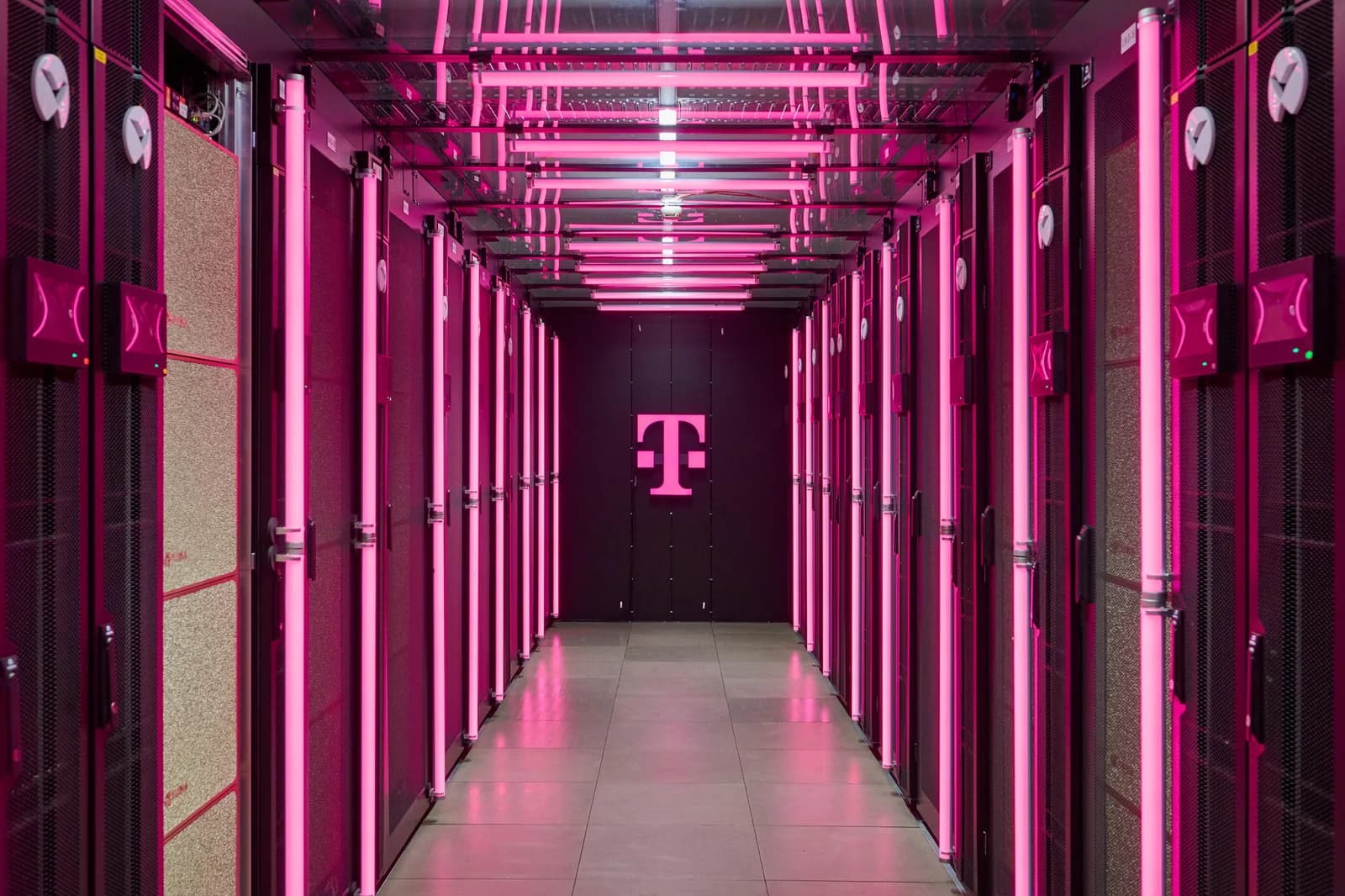
More computing power for artificial intelligence. Deutsche Telekom will continue to expand its AI factory at Munich's Tucherpark. Tim Höttges, CEO of Deutsche Telekom, announced this today at a company press conference in Munich. Additional GPUs from the latest NVIDIA Blackwell Ultra Generation (B300) will join the NVIDIA Blackwell B200 systems. This doubles the number of chips in this class at Telekom. With their higher performance, computing capacity will increase even more significantly. The AI factory will also continue to use NVIDIA RTX PRO 6000 Blackwell Server Edition GPUs.
Telekom is responding to strong demand for high-performance AI infrastructure by investing nearly another quarter of a billion in the technological future readiness of Germany and Europe. The expansion will increase the AI Factory’s capacity to 20 megawatts. Additional NVIDIA Blackwell-Ultra B300 systems provide more computing power for demanding AI applications—from training and operating large AI models to complex reasoning tasks and simulations. Physical AI also benefits: Companies can simulate virtual environments and, for example, test how robots, products, or production facilities respond under realistic conditions. This makes it possible to accomplish in just a few hours what currently takes weeks or months. Companies can also train their own AI models in the AI Factory.
Germany must not only be a user of AI; it must also create value and prosperity itself. Telekom has moved forward here at a rapid pace. Now we are taking the next step and expanding. So ideas become innovative products, and innovations become growth. The world must take Europe seriously. Powerful AI emerges from the interplay of computing capacity, secure data spaces, high-performance connectivity, and a sovereign, secure environment. Together with partners from industry, academia, and the public sector, Telekom brings these building blocks together into a European AI ecosystem. The goal is not only to develop AI, but to put it into practice as a scalable business model – delivering measurable efficiency gains, new products, and additional value creation in Germany and Europe. Telekom CEO Tim Höttges
Germany must not only be a user of AI; it must also create value and prosperity itself. Telekom has moved forward here at a rapid pace. Now we are taking the next step and expanding. So ideas become innovative products, and innovations become growth. The world must take Europe seriously. Powerful AI emerges from the interplay of computing capacity, secure data spaces, high-performance connectivity, and a sovereign, secure environment. Together with partners from industry, academia, and the public sector, Telekom brings these building blocks together into a European AI ecosystem. The goal is not only to develop AI, but to put it into practice as a scalable business model – delivering measurable efficiency gains, new products, and additional value creation in Germany and Europe.
Telekom CEO Tim Höttges
Expansion after just seven months
The Industrial AI Cloud (AI factory) at Munich's Tucherpark only went live in February 2026. Companies, startups, research organizations, and the public sector can develop, train, and deploy AI applications in production there. The initial expansion alone increased available AI computing capacity in Germany by 50 percent and was fully booked just seven months later. Telekom therefore began planning further expansion stages as early as May.
In doing so, Telekom is delivering on its announcement from February: a promise made and kept. The first expansion stage is at capacity, industrial companies such as Siemens and Daimler Truck are already using the infrastructure, and a strong project pipeline indicates further demand. The expansion is therefore the next step toward moving AI computing capacity in Germany from pilot projects to broad industrial deployment. Dr. Ferri Abolhassan, a member of Telekom's Board of Management and CEO of T-Systems
In doing so, Telekom is delivering on its announcement from February: a promise made and kept. The first expansion stage is at capacity, industrial companies such as Siemens and Daimler Truck are already using the infrastructure, and a strong project pipeline indicates further demand. The expansion is therefore the next step toward moving AI computing capacity in Germany from pilot projects to broad industrial deployment.
Dr. Ferri Abolhassan, a member of Telekom's Board of Management and CEO of T-Systems
Investment in Germany's AI infrastructure
This gives companies access to high-performance AI infrastructure that meets European requirements for data protection, security, and data control. Growing demand for this capacity also shows how quickly AI is moving from research and pilot projects into real-world business applications. Companies and institutes such as Currenta, Siemens, Synopsis, Agile Robots, Wandelbots, PhysicsX, Noxtua, EDAG, and Soofi already use the infrastructure for industrial AI, robotics, simulations, language models such as the open NVIDIA model Nemotron and the German language model Soofi, as well as other data-intensive applications.
The focus is on tangible benefits for customers: Companies can simulate production processes, develop robotics and digital twins, train language models, and deploy AI applications securely. One example is Soofi, a language model developed in Germany that is being trained on Telekom infrastructure. In this way, the AI factory supports not only industrial value creation but also technological sovereignty in Germany and Europe.
And there is more: Telekom is currently exploring with partners how to expand its commitment in Bavaria. Discussions are at an intensive stage. Implementation depends on sustainable financial conditions, reliable financing, and an overall economically viable model. A final investment decision has not yet been made.
Quotes
Karsten Wildberger, Federal Minister for Digital Affairs and State Modernization "Telekom thinks big and acts fast. In just a few months, it went from an idea to operations; after one year, it was fully booked, and now it is doubling capacity. This is exactly the mindset and pace we need to win the AI race for Germany and Europe. The federal government will do its part to help make further successes like this possible."
Roland Busch, CEO Siemens "Industrial AI is the opportunity of the century—for our customers, industry, and our entire country. The next stage of AI development will be decided in the real world: where products are made, people work, and value is created. This is precisely where Germany is strong, because we have the necessary expertise, data, and bright minds. Now we need to consistently combine this strength with AI, reinvent our industry, and create new growth and prosperity. Expanding AI infrastructure is enormously important so that this opportunity of the century becomes a German success story."
What to know about the AI factory
NVIDIA Blackwell Ultra Systems GPUs (B300) The new chips are designed for especially compute-intensive AI applications. Their focus is on training and inference for large AI models, AI reasoning, and agentic applications. The additional capacity therefore expands companies’ options for moving AI from pilot projects into production. Industrial applications need powerful computing resources for this, including for training AI models and deploying agentic AI. Depending on the application, digital twins, simulations, and robotics also use additional GPU classes and software such as NVIDIA CUDA X and the Omniverse library.
Energy-efficient AI—and heat for Tucherpark High-performance AI requires substantial computing power. This makes efficient operation of the necessary infrastructure all the more important. The Industrial AI Cloud in Munich achieves a PUE - Power Usage Effectiveness value of 1.2. The PUE - Power Usage Effectiveness metric shows how much additional energy a data center requires beyond IT itself—for cooling and power supply, for example. The closer it is to 1.0, the lower the additional consumption.
Including cooling and other infrastructure, the AI factory requires less than 1.2 kilowatt-hours of electricity for every kilowatt-hour of IT consumption. The resulting waste heat will also be put to good use in the future: it will supply the entire Tucherpark district with heat.
About Deutsche Telekom: Deutsche Telekom Group Profile