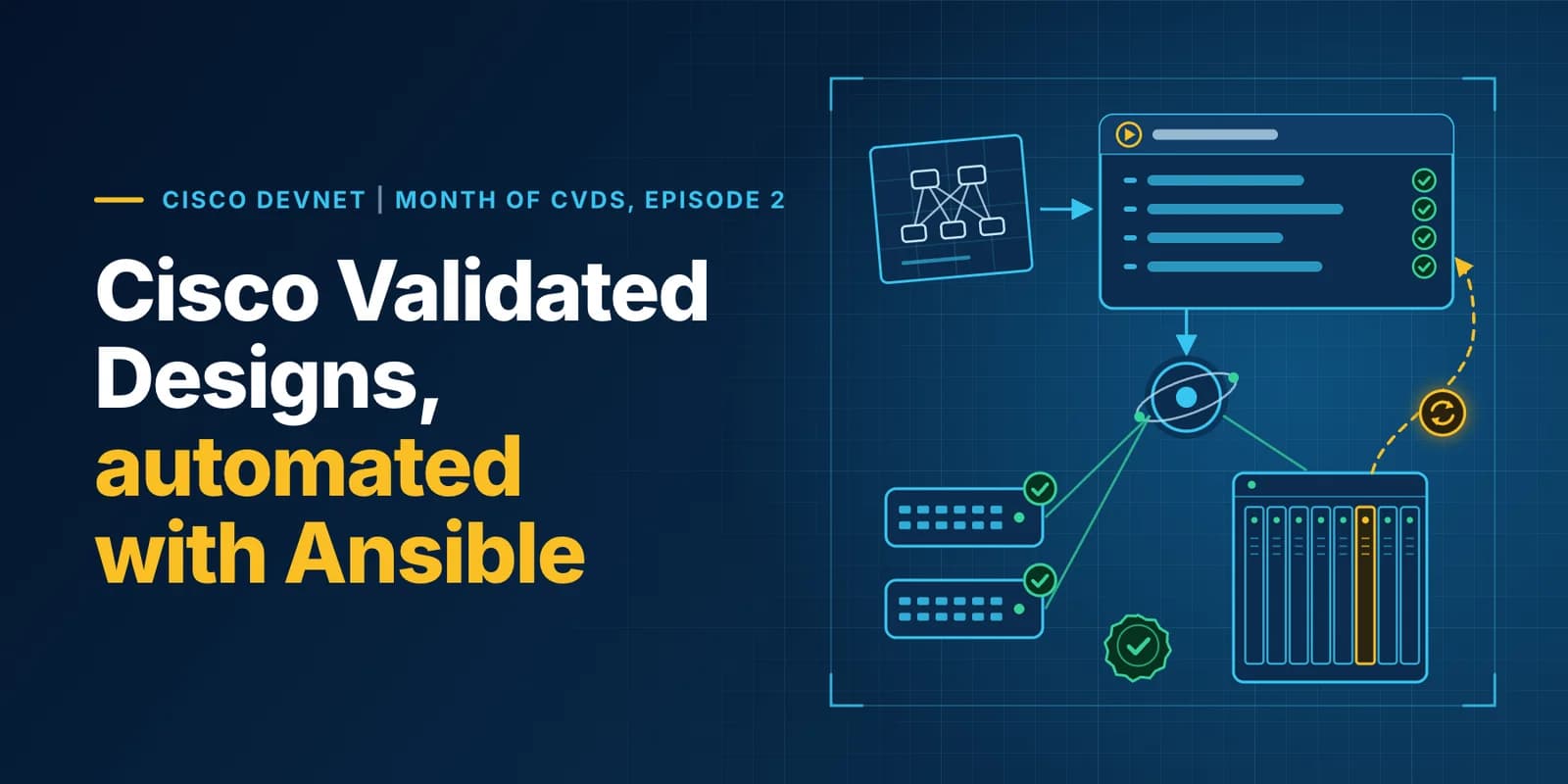
In our second episode of the “Month of Cisco Validated Designs (CVDs),” we sat down with Stephen Fulmer from Red Hat and Archana Sharma from Cisco to discuss a powerful, multi-year collaboration that is reshaping how enterprises deploy and manage their infrastructure, using data center automation with CVDs and Red Hat Ansible.
The core of this partnership? Combining Cisco’s deep expertise in networking and data center hardware with Red Hat’s industry-leading Ansible automation capabilities.
From manual documentation to CVDs that ship with Automated Precision.
For years, Cisco has published CVDs: rigorously tested and validated design documents. However, as infrastructure complexity has grown, the teams recognized a need to move from purely manual documentation to automated, repeatable processes.
By bringing Red Hat Ansible into CVDs, the teams have moved beyond static guides. “We don’t expect customers to take it as is and deploy it,” Archana says of a CVD. “We expect customers to use this as a starting point to modify their designs.”
That’s why a CVD gives you the manual steps and the automation side by side. The deployment chapters live in the same Git repo as the Ansible code. That way, you can adapt the design to your own business needs. You can browse CVD automation in the Cisco UCS Compute Solutions organization on GitHub.
The Cisco Intersight Ansible collection grew to 137 modules
A standout success of this partnership is the Cisco Intersight Ansible collection. It started with about a dozen modules built on older APIs. Rebuilt on modern APIs, it has grown to 137 modules. Stephen says customers now run millions of jobs with it every month.
The lesson the team took from it: When networking experts and automation experts align early, the result is a solution that holds up at scale.
Data center automation for Day 2 operations and compliance
Automation isn’t just about initial deployment; it’s about maintaining the environment. The collaboration emphasizes:
- Drift management: Keeping infrastructure compliant long after it is stood up.
- Security guardrails: Embedding role-based access control (RBAC) and audit logs into the automation flow to ensure human oversight in AI-driven processes.
- Unified support: With the joint support model, customers get one purchase and one support path. For the Intersight content, Red Hat takes the first call and triages with Cisco support. Nobody is left pointing fingers between vendors in a mixed environment.
To see these ideas in a validated design, read the CVD on Day 2 automation with Cisco compute and Red Hat Ansible.
Looking ahead: The AI Pod CVD
The team also gave a sneak peek at the upcoming AI Pod CVD. Featuring Cisco UCS X-Series and Nexus infrastructure alongside Everpure (formerly Pure Storage), this new design focuses on inferencing platforms. Those are the systems that serve trained models in production. It will join Cisco’s existing AI PODs.
The CVD is expected in about a month, with the Ansible automation shortly after. The goal we discussed: use Ansible to automate the setup of the entire AI stack, cutting deployment time from months toward hours.
Empowering the Future: What’s next for Cisco and Red Hat
The partnership keeps growing into OpenShift, virtualization, and AI infrastructure, with the same approach: tested designs, automation you can adapt, and one support path when something breaks. For data center automation, that means you start from a validated design and working playbooks instead of a blank page.
Watch episode 2 of the DevNet Month of Cisco Validated Designs on YouTube for the full conversation with Archana and Stephen. If you missed the kickoff, start with the episode 1 post, Welcome to the DevNet Month of Cisco Validated Designs.
Next week, we’ll dive deeper into the technical architecture of the AI Pod, with a live look at the automation process.
For more architectural blueprints, visit the Cisco Design Zone and the Cisco Intersight collection documentation. Join us every Thursday this month of November for a new episode of the DevNet Month of Cisco Validated Designs.