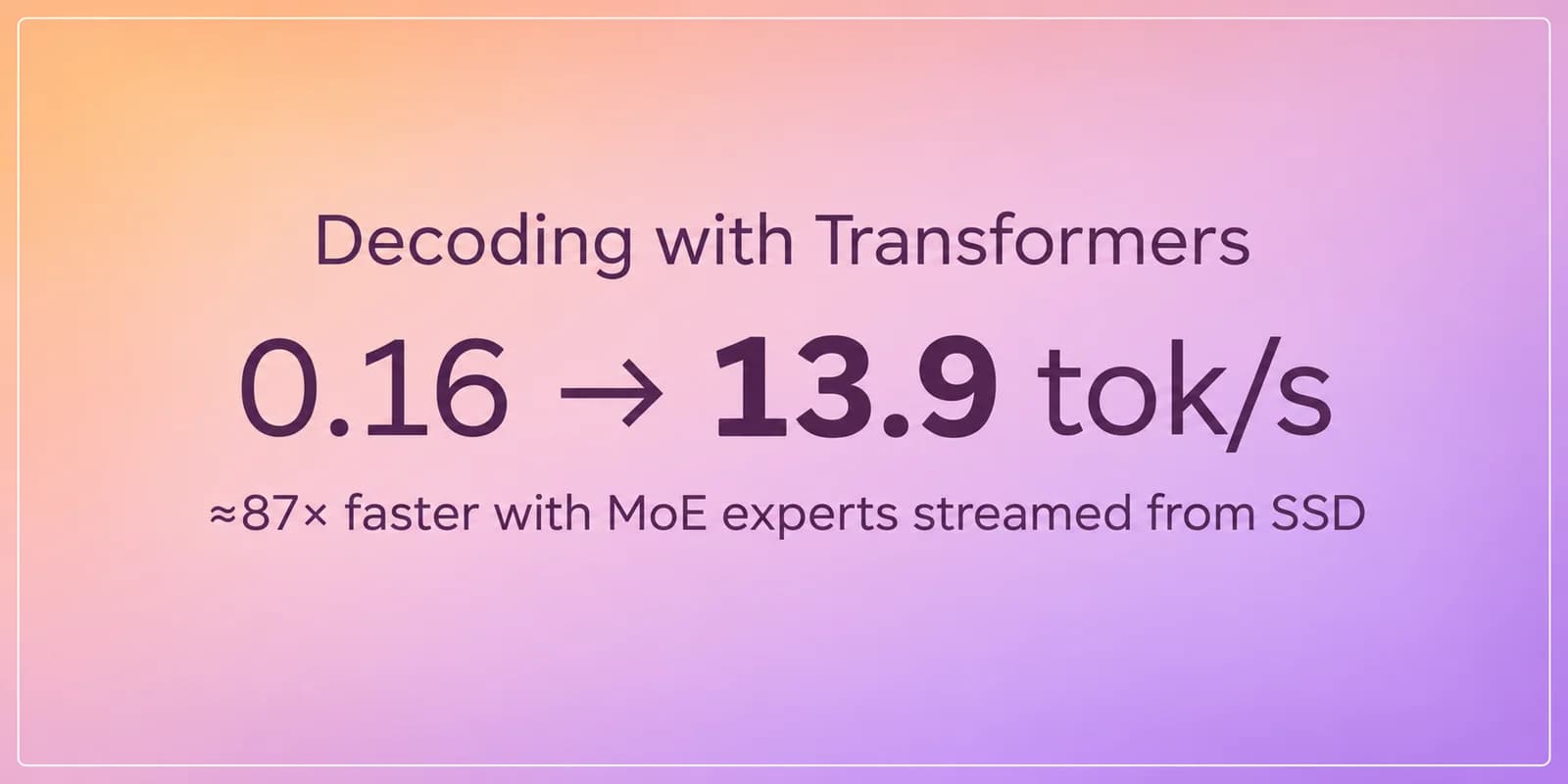
Streaming MoE experts directly from SSD gets within 6% of Strata on token generation.
I've been trying to rely less on online models and run bigger ones locally. At home I have a PC with two RTX 4090s (let's call it Orthrus - the two-headed hound of Greek mythology), and for work I have a MacBook M5 with 32G of unified memory.
Orthrus runs on Windows 11, because my kids play games all the time. I had a dual boot with Ubuntu, but their games ended up taking most of the two terabytes of disk.
I am also a huge fan of RMD (rooms moving development): one hour in the kitchen sipping my coffee, two hours at my office desk, then the sofa. A fixed desktop tower is not for me.
My first experiment was to run Qwen 3.8 27B with llama.app on Orthrus and use it from my laptop through pi. That model does the coding tasks, an online model like Opus does the orchestration, and the second RTX runs a FIM model for auto-completion in Neovim.
When I talked about this on social networks, I got very strong feedback: use Strata with Qwen3.8-Flash-Next.
What is Strata?
Strata is an inference engine for MoE models like Qwen. Only the hot experts stay in VRAM, the rest goes to RAM, or even to disk. Experts are 90%+ of a MoE model's weights, so a 180B model like this one can run on a GPU with much less memory. Like my RTX 4090!
It works on a laptop too, and I stumbled on this blog post doing exactly that: Qwen3.8-Flash-Next on a 32 GB Mac M4, faster than llama.cpp, at 13.5 tok/s.
That's too slow for how I use coding agents, but it's an interesting itch to scratch. A whole range of MoE models don't fit in a MacBook's unified memory and could run at a decent speed.
How do other engines offload?
Before committing to Strata, I looked at what llama.cpp, vLLM and Transformers do when a MoE model doesn't fit. Three questions matter: where do the experts live, where does the expert matmul run, and what moves on each token?
llama.cpp maps the GGUF file with mmap and can keep the experts on the CPU (--cpu-moe, --n-cpu-moe N, -ot "exps=CPU", or --fit on to pick for you). Those experts are also computed on the CPU, so only the activations cross PCIe, never the weights. Great when the experts fit in RAM. When they don't, the page cache thrashes. A GPU expert cache (--moe-cache-mib) just landed, but it fragments the graph (2 splits per token become 50) and loses ~10% even when everything fits.
vLLM's --cpu-offload-gb N puts N GB of weights in pinned RAM, and kernels read them in place over PCIe. For a MoE layer, that's only the routed experts, but nothing is cached: a hot expert crosses PCIe again on every token, and there's no disk tier. By default the offloaded weights include dense layers, read on every token; --cpu-offload-params experts keeps it to the experts. That fits vLLM's big batches, which touch almost every expert anyway, less so one user on one GPU.
Transformers offloads through Accelerate (device_map="auto", offload_folder), one module at a time: hooks copy its weights to the GPU before forward. For a MoE, that module is a layer's whole expert bank, so every token copies every expert of every offloaded layer to use 8 or 10 of them. No cache, no notion of routing. And on a Mac, CPU and GPU share the same memory, so "offload to CPU" frees nothing.
I ran all of them on Qwen3.6-35B-A3B on one A10G (24 GB), with plenty of RAM, and Harry Mellor reran vLLM with better flags:
Offloading only the experts doubles vLLM's speed, and FP8 helps on top (half the bytes per expert, more of the model on the GPU). vLLM's other offload backend, which copies groups of layers ahead of time, ran under 1 tok/s.
If the experts fit in RAM, llama.cpp is hard to beat. If they don't, you have to stream only what the router picks, through a bounded cache, fast enough that the SSD is the bottleneck and not Python, ideally reusing the model's fast expert kernels. That's Qwen3.8-Flash-Next on a 32 GB Mac, and Transformers couldn't do it out of the box.
Making Qwen3.8-Flash-Next work on my 32 GB Mac with Transformers
Strata was already too slow for me on the laptop, and Transformers was not going to beat it anytime soon. But the Accelerate path was so far off that I wanted to try fixing offloading in Transformers itself, with the big model on my laptop as the target, knowing it would probably stay too slow for how I work.
All of the code was built with AI: the Transformers PR, the model-specific package and the Metal kernels. My part was choosing what to try, reading the profiles, and deciding what to keep. Everything is in a Space: tarekziade/moe-expert-streaming.
Start small
I started with OLMoE-1B-7B, which fits in memory, so I could compare every token with vanilla Transformers.
First version: experts on disk, an LRU cache on the device, and a Python loop running one expert at a time. With every expert already cached, it did 10.1 tok/s. Vanilla did ~32. The I/O was fine, my loop was not: vanilla uses grouped_mm, which runs all the experts of a layer in one kernel.
The fix, and the key idea of this project, was to turn the cache into a slot pool: one preallocated device tensor shared by all layers, plus a per-layer table from expert id to slot. Remap the router's expert ids to slots and the pool looks like a regular expert bank, so grouped_mm runs on it as is. No custom expert matmul needed. That got it to 34.6 tok/s, against 38.1 for vanilla.
experts_offload
I then turned the standalone loader into an option of from_pretrained, in huggingface/transformers#50717. To try it, install Transformers from that PR:
Then, moving from OLMoE to the real target, Qwen3.8-Flash-Next:
That repo holds the output of the project's conversion script: the dense weights, the experts quantized to 3 bits, and the n-gram table.
Experts mapped to "disk" go through the streaming path instead of Accelerate's offload: the loader skips their tensors and MoE layers switch to an offloaded implementation. Misses are read by 8 I/O threads, one contiguous read per expert. The next two layers' routers run early on the current hidden states to guess which experts to prefetch. Experts can be quantized offline so reads are smaller. It works for MoE models with the standard experts layout.
The API is still being discussed with the Transformers maintainers. The device_map form came out of that, and quantized experts will probably go through the per-layer quantization plan of #50245 rather than their own option.
Running 121 GB of experts on a 32 GB Mac
Qwen3.8-Flash-Next has 48 layers of 512 experts (10 active), 121 GB in FP8. Streaming them isn't enough: there's also a 51 GB n-gram embedding table that needs its own disk path. So:
- experts quantized to 3 bits: 49 GB on disk, 12 GiB cached on the device
- dense layers in 8 bits (~5.4 GB, +0.2% perplexity vs BF16)
- the n-gram table stays on disk, rows read when needed
The conversion takes ~5 hours. After loading, it uses ~18 GiB, and a 6K prompt peaks at 25.4 GiB. That's about the limit: I have to close the browser, or macOS starts swapping.
The model-specific bits (the n-gram table, Metal kernels) live in a small package, , on top of the PR. The first version ran at about 10 tok/s.
Then I installed Strata on the same M5, with the same prompts:
Strata 0.1.60 used IQ3_XXS experts. Both ran greedy, with thinking, MTP and speculative drafts off, and 1,024-token prefill chunks. The full setup and raw results are on the Space's details page.
I also tried vllm-metal, vLLM on Apple GPUs through MLX, which recently got expert offloading. It streams the routed experts from an MLX checkpoint through a bounded cache, like this project. But it can't run Qwen3.8-Flash-Next on 32 GB, for the n-gram reason above: only the experts are streamed, and the n-gram tables stay in memory. That's 32 GB in the MLX checkpoints on the Hub, before the ~5 GB of dense layers and any expert cache.
Closing the gap
Most of the time wasn't spent on experts. Here's what helped:
- Committing GPU work early. PyTorch on MPS holds small kernels until the next sync, so the GPU idled while Python worked. Forcing a commit after each block gave +10%. This should really be fixed in PyTorch.
- Metal kernels for the parts without a fast path on macOS: Gated DeltaNet and the hyper-connections.
- Strata's own weights. I switched to Strata's GGUF weights, reducing dense weight traffic from 5.4 GB to 3.9 GB per token and individual expert size from 2.15 MB to 1.75 MB, with a separate cache pool for each expert size.
- Prefill, we went from 68 to ~228 tok/s using bigger chunks, and reading the next layer's experts while the current layer is being computed.
- Long documents: attention over the indexer's selected blocks only, and a KV cache that grows in place instead of being copied at every token.
- Misses: Strata doesn't hide them, it waits like I do, and no cache policy beat LRU by much. What helped was reading just one guessed expert per layer, while the SSD would otherwise be idle.
Here's one MoE layer for one token, as it runs now:
These are the final results after these optimizations on the same M5 with the same prompts:
That's about 6% behind Strata on short decode, with slightly faster prefill, all through Transformers.
Most of what's left is host round trips, ~10 ms per token. Waking up after a sync is only ~1 ms of that. The rest is the GPU running dry while Python queues the next layer. Strata queues the whole token's work up front, and the GPU waits on a Metal shared event at each layer while the host reads experts. PyTorch doesn't expose that. I tried to fake it with a kernel spinning on a flag the CPU writes, and the GPU took anywhere from a second to never to see the write. The real fix would be a native op on PyTorch's MPS stream, with a risk of hangs, so I haven't built it.
Conclusion
It runs at ~14 tok/s, close to Strata, and it's still too slow for how I use coding agents. Orthrus keeps doing the real work.
Transformers didn't beat Strata, and closing the last ~6% would take deeper changes in the stack, starting with control over that per-layer sync, which PyTorch doesn't give you today. The interesting part is how it got that close: streaming only the routed experts, a bounded cache that grouped_mm runs on as is, and a few targeted Metal kernels. There's no C++ extension in the project: just Python, Metal kernels compiled at runtime with torch.mps.compile_shader, and prebuilt kernels from the Hub. All the Metal kernels written for this experiment are now published on the Hub, and the project loads them from there.
Beating Strata was never the only goal, though. Building this was a great way to learn how MoEs and LLMs work from a systems perspective: how sparse the routing really is, how much an expert cache buys you, where memory bandwidth goes per token, and how much time the host and the GPU spend waiting on each other. Transformers makes all of that easy to poke at, one module at a time.
The generic expert streaming implementation is in , and the benchmarks are in the Space. Feedback on the approach and the API is welcome.
Thanks to Pedro, Lysandre and Arthur for their excellent feedback, and to Harry for helping test vLLM.
Finally, thanks to Niko Veit for . Strata set the bar for what's possible with expert streaming on consumer hardware, and having those numbers to chase is what pushed this work as far as it went.